Breathing Exercises for Menopause: A Complete Guide by Symptom
A wave of heat in the middle of a meeting. Wide awake at 3am with your heart already running. A familiar word that simply will not come. Menopause can make your body feel like it is on a hair trigger, and most advice either sells you something or tells you to push through.
In short: Breathing exercises for menopause are short, slow breathing practices that may help you feel calmer through hot flushes, 3am wake-ups, anxiety and brain fog. The core pattern is simple: breathe in for 4 and out for 6, about 6 breaths a minute, for 5 minutes. They will not stop symptoms, but many women find them a steadying anchor.
This is the long version. If you want to understand which breath suits which symptom, settle in.
ये गाइड आपके लिए है। आराम से पढ़िए।
Why does breathing help in menopause?
Menopause is not a disease. It is a transition. But the symptoms are real, and many of them seem to share one feeling: a nervous system that has become more reactive. Heat comes faster. Sleep breaks more easily. Worry arrives from nowhere.
Your breath is the one input you can change at any moment. Slow breathing at about 6 breaths a minute is linked with calmer heart-rate patterns and the body's "rest and digest" response, the side of your nervous system that slows things down. A 2023 Stanford study found that 5 minutes a day of cyclic sighing, two inhales through the nose and one long exhale through the mouth, improved mood over a month, more than mindfulness meditation did.
Breathing will not replace your hormones. What it can do is give you something to hold on to while they change.
What is the one rule for every breathing exercise?
Before the patterns, before the timer, one rule.
Make your out-breath longer than your in-breath.
That is it. Not deeper breaths. Not louder breaths. Not perfect breaths. A longer exhale, repeated slowly for five minutes. A 4-in, 6-out pattern takes you to about 6 breaths a minute. But 3-in, 5-out works. So does 4-in, 7-out. The direction matters more than the exact numbers.
साँस अंदर लेना ज़रूरी है, पर सुकून लंबी साँस छोड़ने से शुरू होता है।
You cannot do this wrong. If your mind wanders to the dishes or the deadline, keep breathing. You don't need concentration. You need a slow exhale.
Try this now: the 4-6 foundation breath
- Settle where you are. Sit, lie down or stand. Bed, car, office chair. Rest one hand on your belly.
- Breathe in through your nose for 4 counts. Let your belly rise rather than your chest.
- Breathe out for 6 counts. Through your nose or softly through your mouth.
- Repeat for 5 minutes. About 30 breaths. If you lose count, simply start again.
Which breathing exercise helps which menopause symptom?
Different moments call for slightly different breaths. Here is a gentle map. Each links to a deeper post if you want more.
Hot flashes
Let's be honest here. Early small studies of paced breathing for hot flushes were promising, but a larger 2013 trial found no clear drop in how often they happen. Breathing may still help you feel calmer and more in control while one passes, and that matters when you are mid-flash in a meeting.
Try: 4-in, 6-out at the first sign of warmth, with your shoulders soft. Start with 5-minute breathing for hot flashes, and read what the science actually says.
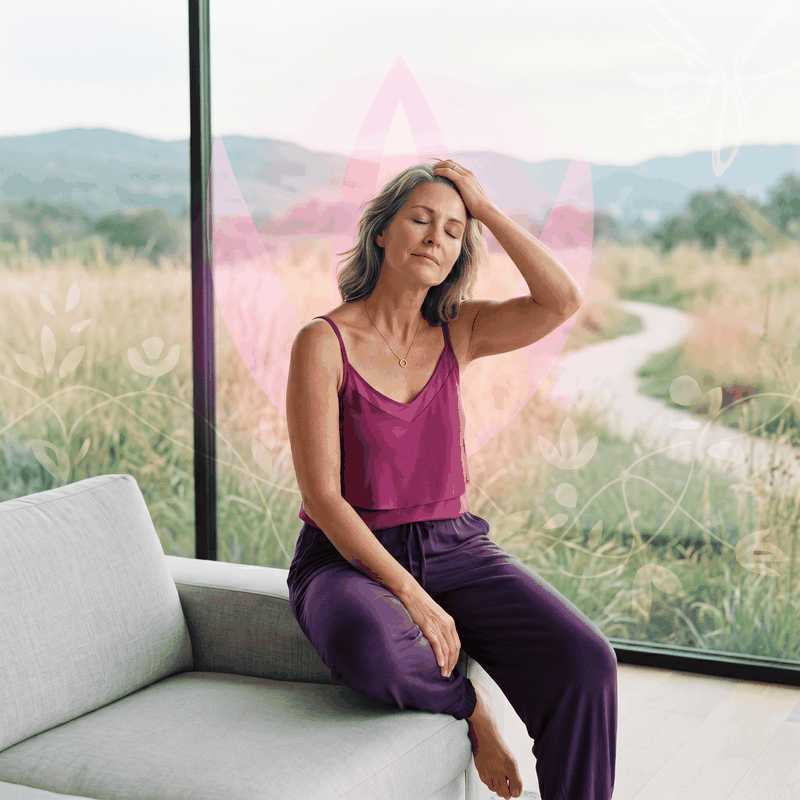
Sleep, especially the 2am to 4am wake-up
So many women wake in the small hours wide-eyed, with a heart that is already running. A slow breath with a gentle pause helps slow the system down without forcing sleep. The aim is not to fall asleep. The aim is to stop the racing. Sleep often follows.
Try: In for 4, a soft pause for 4, out for 6, for ten rounds, lying on your back or side. Start with It Is 2am and You Cannot Sleep.
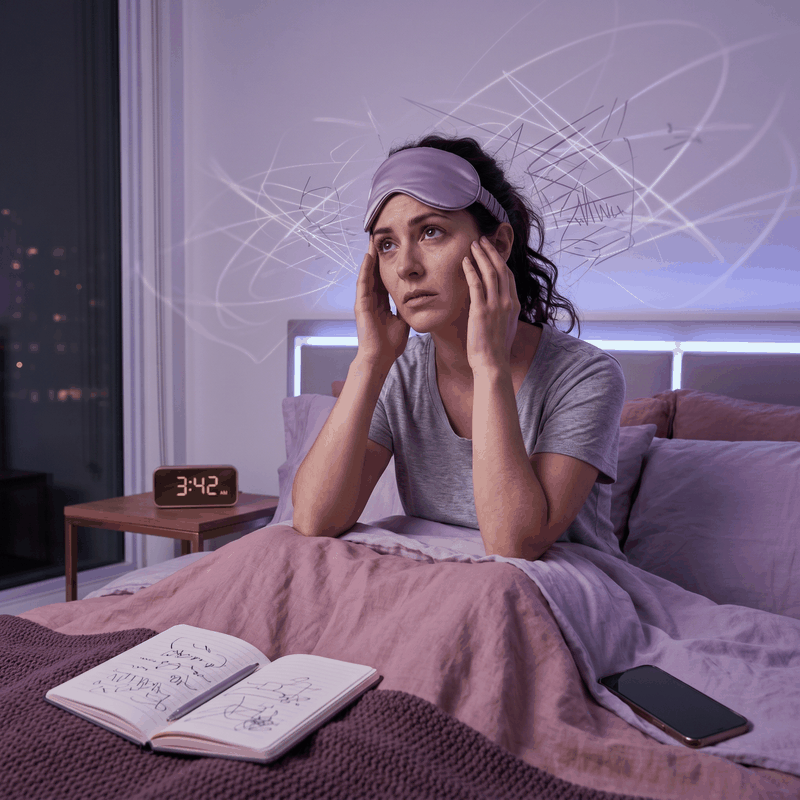
Anxiety
Anxiety in perimenopause often feels like it has no cause. A long, conscious exhale gives you a way to interrupt the spiral before it takes over.
Try: 4-in, 7-out, soft and unforced, for 5 minutes. Start with breathing for anxiety at night.
Mood swings and irritability
When something lights you up, a few slow breaths can widen the gap between the trigger and your response.
Try: In for 4, a gentle pause for 2, out for 6, ideally before you reply to the thing that set you off.
Brain fog
When your mind feels racing and blank at the same time, an even, counted rhythm gives it something simple to follow.
Try: Box breathing. In for 4, hold for 4, out for 4, hold for 4, for a few minutes. If the holds feel uncomfortable, shorten them.

The constant low hum of stress
If you cannot point to one symptom and instead feel a low hum that follows you all day, the simple 4-6 breath, once or twice a day, is the foundation everything else sits on. If you only do one, do this one. Here is what happens when you breathe for 5 minutes, and the honest science on breathing and cortisol.
Can I do breathing exercises in Hindi?
Yes. If English wellness language has always felt like it was written for someone else, you are not alone. The breathing is the same. The feeling can be very different. Hindi guided breathing for women over 40 explains why, and MySakhi has Hindi guided practices free at mysakhi.life/hi.
You are allowed to take five minutes
Most women do not start a breathing practice because they do not feel they have permission to stop in a day that belongs to everyone else.
It is okay to sit in the car after you park. It is okay to close the bathroom door. It is okay to put the phone down mid-scroll and breathe instead. It is okay to be the only person in the house doing nothing for five minutes.
आपको इजाज़त है।
You are not wasting time. Not this: pushing through until you snap. This instead: five slow minutes, before you need them.
How do I actually start?
You don't need to learn every pattern. You need one symptom and one slot in your day.
- Days 1 to 7: Pick the symptom that bothers you most. Do its breath once a day, at roughly the same time, for 5 minutes.
- Days 8 to 14: Add a second slot. Morning before your phone, or evening before sleep.
- Day 15 onwards: Use a breath in the moment, too. Heat rising? Long exhale. Heart racing at 3am? The soft-pause breath. A meeting that landed badly? 4-in, 7-out in the bathroom.
That is the whole programme. One symptom at a time.
When should I see a doctor?
Breathing is support, not treatment. If symptoms are affecting your sleep, work, relationships or mood, talk to your doctor. Hormone therapy is the most effective treatment for hot flushes for many women, and it is a conversation worth having. The UK's NICE guidance also includes CBT as one option for hot flushes, night sweats, sleep problems and low mood linked to menopause.
Get urgent care for chest pain, fainting, breathlessness, or palpitations that do not settle. If you have thoughts of harming yourself, contact your local emergency services or a crisis helpline now. For a wider view, see the full list of menopause symptoms.
Start your first moment
You do not need to understand the science or fix everything at once. Choose the symptom that bothers you most this week, and breathe for it for five minutes.
If you would like a voice to guide you, press play on a practice in the MySakhi library, or tell Sakhi what is loudest tonight and she will suggest something for that moment. In the free MySakhi app, you can also join Circles like Restful Nights and Cool Down, small groups of women in the same chapter.
5 minutes. No mat. No mantra. Just you.
Questions women ask
What is the best breathing exercise for menopause symptoms?+
A slow 4-in, 6-out pattern is the easiest place to start. It brings you to about 6 breaths a minute, a pace linked with calmer heart-rate patterns and the body's 'rest and digest' response.
Can breathing exercises stop hot flashes?+
No breathing exercise can promise that. Early small studies were promising, but a larger 2013 trial found no clear drop in how often hot flushes happen. Slow breathing may still help you feel calmer while one passes.
How long before breathing exercises help?+
Many women feel a little calmer within one 5-minute practice. In a 2023 Stanford study, 5 minutes a day of cyclic sighing for a month improved mood, so returning to it daily tends to help most.
Do I need to practise breathing every day?+
Daily is lovely, but whenever you can is fine. Even one 5-minute practice on a hard night counts. There is no streak to keep and no way to fall behind.
Is breathing a replacement for HRT or medication?+
No. Breathing is wellness support, not medical treatment. Hormone therapy is the most effective treatment for hot flushes for many women, so talk to your doctor about all your options.
Listen free, wherever you are