5-Minute Breathing Benefits: What Actually Happens in Your Body
You have probably heard people say "just breathe". And you have probably thought: I breathe all day. What is 5 minutes going to change?
Fair question. When you are running between work calls, school pick-ups, dinner, and a body that has started doing things it never did before, "just breathe" sounds like advice from someone who has never had your day.
साँस तो हम दिन भर लेते हैं। पर रुककर साँस लेना, वो अलग बात है।
In short: The main 5-minute breathing benefits come from slowing down to about 6 breaths a minute with a longer out-breath. That pace is linked with calmer heart-rate patterns and the body's "rest and digest" response. A 2023 Stanford study found 5 minutes a day of cyclic sighing for a month improved mood and lowered breathing rate, and helped more than mindfulness meditation.
Here is what nobody tells you: there is a difference between the breathing you do on autopilot and the breathing you do on purpose. One keeps you alive. The other tells your body it is allowed to stand down.
What happens in your body when you breathe slowly?
Your nervous system has two broad modes. One is the alert, get-things-done side, sometimes called fight or flight. The other is the "rest and digest" side, which slows you down so your body can recover. Most of us spend our days tipped heavily towards the first.
Slow breathing at about 6 breaths a minute is linked with calmer heart-rate patterns and a shift towards that rest and digest side. A 4-6 rhythm, 4 counts in and 6 counts out, lands right on that pace: ten seconds per breath, six breaths a minute.
The best study we have on short daily practice comes from Stanford in 2023 (Balban and colleagues, published in Cell Reports Medicine). People who did 5 minutes a day of cyclic sighing, two inhales through the nose followed by one long exhale through the mouth, for a month saw their mood improve and their breathing rate fall. In that study it helped more than mindfulness meditation.
What science cannot yet tell you is exactly how much any one hormone drops in a single 5 minutes. You may see headlines promising precise percentages. We would rather be honest with you: the evidence points in a hopeful direction, and the rest is what you notice in your own body.
What you might notice, minute by minute
Everyone is different, and there is no right result. But this is what many women describe.
Minute 1: your attention lands
The first minute is often the noisiest. Your mind is still running the list. That is fine. You are simply arriving, breath by breath.
Minute 2: the chest loosens
As the out-breath lengthens, many women feel the tightness in their chest or throat begin to ease. The urgency softens a little.
Minute 3: the muscles let go
You have been holding tension in your jaw, your shoulders, your hands. You probably did not notice until now. Somewhere around here, shoulders drop and hands unclench, often without you asking them to.
Minute 4: the chatter quietens
You are still fully awake, but the to-do list stops scrolling quite so fast. Thoughts come and go a little more slowly.
Minute 5: a small reset
By the end you will not feel transformed. You may feel slightly more here, slightly less alarmed. That counts.
You are allowed to take 5 minutes for nothing productive
The reason most women do not do this is not doubt about the science. It is that taking 5 minutes for yourself feels indulgent. Selfish. Like there is always something more important.
अपने लिए 5 मिनट लेना कोई गुनाह नहीं है।
You are allowed to sit on the edge of your bed and breathe before the alarm goes off. You are allowed to close the bathroom door and take 30 slow breaths before you face the evening. You are allowed to do something with no output and call it enough.
You cannot do this wrong. If you breathe in for 3 and out for 5 instead of 4 and 6, that still works. If your mind wanders the entire time, the slow breathing is still happening. You don't need concentration. You need breath.
Try this now: a simple 5-minute breath
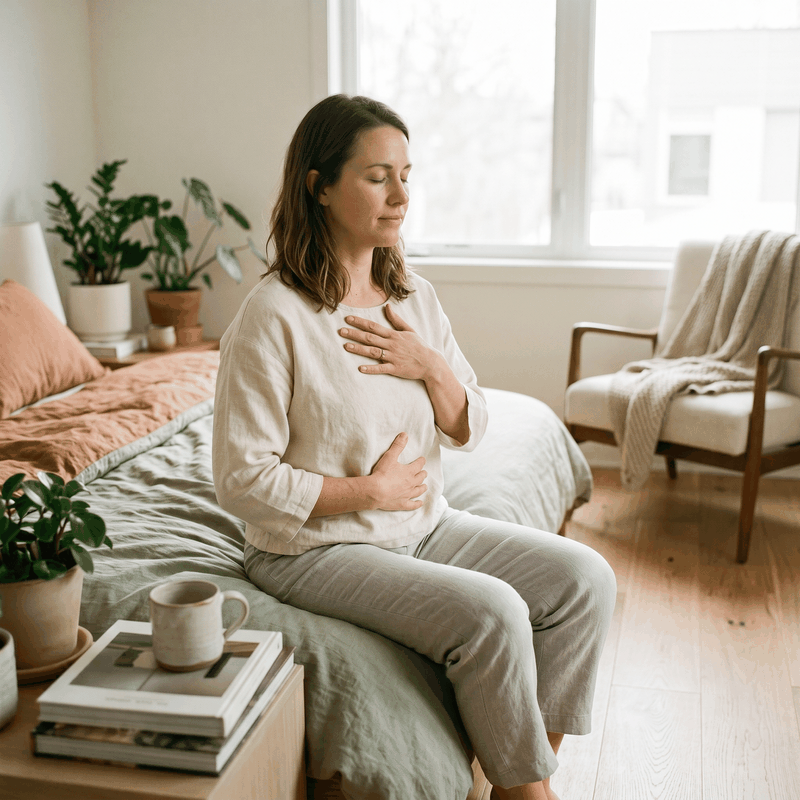
- Find your spot. Sit, lie down or stand. It does not matter where. Close your eyes or soften your gaze, and rest one hand on your belly.
- Breathe in through your nose for 4 counts. Slowly. Feel your belly rise under your hand.
- Breathe out for 6 counts. Through your nose or mouth, slow and steady. The longer out-breath is the part that matters.
- Continue for 5 minutes. That is about 30 breaths. You do not need to count perfectly. Set a timer if it helps.
- Notice what changed. Maybe your shoulders dropped. Maybe nothing dramatic happened. Both are fine.
When can I use a 5-minute breath?
You don't need a special time or place. You need a gap you already have.
- Morning: Before you check your phone, so the first stressful message meets a slightly steadier you.
- Midday: After lunch, when the afternoon slump arrives.
- Night: Before sleep, especially if you are one of the many women who wake at 2am and cannot get back to sleep.
- During a hot flash: Slow breathing will not stop a hot flash, but it may help you feel calmer and more in control while one passes. This practice for hot flashes shows you how.
- When anxiety arrives without warning: If your chest tightens in the evening for no clear reason, the night-time anxiety reset uses this same long out-breath.
Five minutes when everything feels like too much. Press play and let a voice guide you.

When is breathing not enough?
Breathing is a support, not a treatment. If perimenopause symptoms are affecting your sleep, work or relationships, talk to your doctor. For long-term insomnia, CBT for insomnia (CBT-I) is the first-line treatment. For hot flushes, hormone therapy is the most effective option for many women, and that is a conversation to have with your doctor. If you have thoughts of harming yourself, contact your local emergency services or a crisis helpline now.
Start your first moment
What if today's 5 minutes did not have to be earned? Press play on a short practice in the MySakhi library, or tell Sakhi how you feel and let her suggest one for right now.
5 minutes. No mat. No mantra. Just you.
Questions women ask
What are the benefits of breathing slowly for 5 minutes?+
Slow breathing at about 6 breaths a minute is linked with calmer heart-rate patterns and the body's 'rest and digest' response. Many women also notice looser shoulders, a softer chest and a quieter mind by the end of 5 minutes.
Is 5 minutes of breathing enough to make a difference?+
It can be. A 2023 Stanford study found that 5 minutes a day of cyclic sighing for a month improved mood and lowered breathing rate, and it helped more than mindfulness meditation in that study.
Do I need a quiet room to do breathing practice?+
No. You can breathe slowly sitting, lying down or standing, in a car, a bathroom, a kitchen or at your desk. Quiet is nice, but it is not required.
Why should the out-breath be longer than the in-breath?+
A longer out-breath slows your overall breathing rate towards about 6 breaths a minute, the pace linked with the body's calming 'rest and digest' response. A 4-in, 6-out rhythm is an easy way to get there.
Can I do breathing practice every day?+
Yes. Gentle slow breathing is a simple daily practice for most people. If you feel dizzy, go back to normal breathing, and talk to your doctor if you have a heart or lung condition.
Listen free, wherever you are