Breathing for Anxiety at Night: A 5-Minute Reset for a Racing Mind
You know the feeling. The day is done. The kitchen is clean, tomorrow's lunches are packed, everyone else is sorted. And the moment you finally sit down, it hits. Not one specific worry. Just a heaviness in your chest, a tightness in your throat, and a mind that will not switch off.
सब काम हो गया, फिर भी मन को चैन नहीं।
In short: Breathing for anxiety at night works best with a longer out-breath than in-breath. Try 4 counts in and 6 counts out for 5 minutes. That is about 6 breaths a minute, a pace linked with calmer heart-rate patterns and the body's "rest and digest" response. A 2023 Stanford study found 5 minutes a day of cyclic sighing, a breath with a long exhale, improved mood over a month.
Nothing is wrong with you. Your nervous system has been on duty all day, and nobody told it the day is over. Your body is still bracing for the next demand. At night, when the noise stops, the anxiety gets louder.
Why is anxiety worse at night in perimenopause?
During perimenopause, hormone levels rise and fall unpredictably, and many women notice anxiety they never had before. It can arrive without a reason, and it often peaks in the evening, once there is nothing left to distract you. You are tired but wired. Low mood is more likely in this stage too: the long-running SWAN study found the risk of depressive symptoms is 2 to 4 times higher during perimenopause.
This is not a character flaw. This is biology meeting a very full life.
Your breath is the one tool you always carry. It will not fix your hormones. What it can do is send your body a different message: the day is done, and you are safe now. If anxiety has become a daytime companion as well, this guide to perimenopause anxiety goes deeper.
The 5-minute reset: why the out-breath matters
This practice uses a 4-6 pattern. You breathe in for 4 counts and out for 6. The longer exhale is the key. Slow breathing at about 6 breaths a minute is linked with calmer heart-rate patterns and the body's "rest and digest" response, the side of your nervous system that slows everything down.
You can do this sitting on your bed, lying down, in a chair, or standing in the bathroom with the door closed. Wherever you are right now is fine. No mat. No special cushion. No quiet house required.
Try this now: the 4-6 anxiety reset
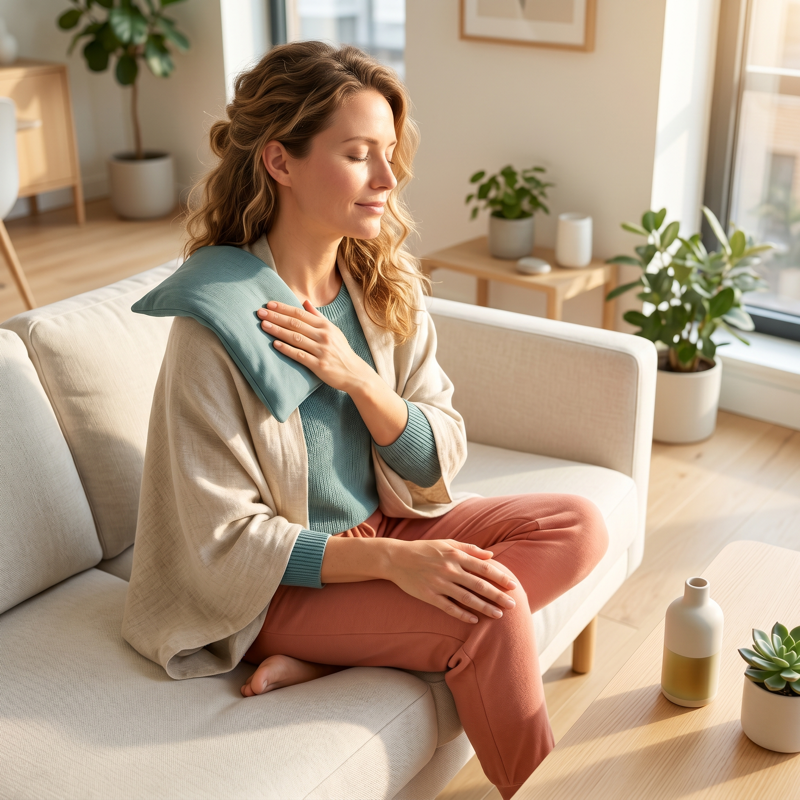
- Stop what you are doing. Put the phone face down. Close your eyes, or soften your gaze on one still point. Rest one hand on your chest and one on your belly.
- Breathe in through your nose for 4 counts. Slowly. Let the breath move down into your belly. If your chest hand rises more than your belly hand, slow down and aim lower.
- Breathe out for 6 counts. Through your nose or softly through your mouth. Let the exhale be longer than feels natural at first. This is where the tightness starts to loosen.
- Repeat for 5 minutes. That is roughly 30 breaths. You do not need to count them all. Set a gentle timer, or keep going until your shoulders drop.
- Notice what shifted. Maybe your jaw unclenched. Maybe your hands softened. Maybe your thoughts slowed from a sprint to a walk. Whatever happened is enough.
साँस बाहर जाए, तो उसके साथ थोड़ी-सी घबराहट को भी जाने दीजिए।
It is okay to feel anxious and not know why
Here is the permission you might need tonight: you do not have to understand your anxiety to soothe it. You do not need to trace it to a thought, solve the problem underneath, or work out what set it off. In perimenopause, anxiety often arrives with no reason at all. That does not mean something is wrong with you. It means your body needs a reset.
You are allowed to take 5 minutes before bed and do nothing but breathe. Not to be productive. Not to become a calmer person by Friday. Just to give your body one clear signal: the day is over.
You cannot do this wrong. If you breathe in for 3 and out for 5, that works. If you lose count, start again. If your mind races the whole way through, the slow breathing is still doing its quiet work underneath.
How do I fit this into my evening?
You don't need a new routine. You need one small slot in the routine you already have.
- In bed, before the phone. Do the reset after you lie down and before you pick up your phone. If you also wake in the small hours, this 2am breathing practice is a gentle companion.
- After a hard evening. If the day's tension is still sitting in your chest, do a round after dinner or once the children are in bed.
- When heat adds to the worry. Physical discomfort and anxiety feed each other. If hot flashes are part of your nights, this 5-minute practice for hot flashes uses the same long out-breath.
What if tonight, instead of scrolling until you are tired enough to drop, you gave your body five slow minutes first? Not this: another hour of the phone's glow. This instead: thirty slow breaths in the dark.

When should I talk to a doctor about anxiety?
Breathing is support, not treatment. Talk to your doctor if anxiety is affecting your sleep, work or relationships, or if it has been building for weeks. You can ask about every option, including CBT, which the UK's NICE menopause guidance includes as one option for low mood linked to menopause. If you want to see where anxiety sits among everything else, here is the full list of menopause symptoms.
If your heart races along with the anxiety, get urgent care for chest pain, fainting, breathlessness, or palpitations that do not settle. And if you ever have thoughts of harming yourself, contact your local emergency services or a crisis helpline now. You do not have to carry that alone.
Start your first moment tonight
If you would rather follow a gentle voice than count on your own, press play on a short practice in the MySakhi library. Or tell Sakhi how tonight feels, and she will suggest something for this exact moment, in English or Hindi.
5 minutes. No mat. No mantra. Just you.
Questions women ask
Does breathing actually help anxiety, or does it just distract you?+
It may do more than distract. Slow breathing at about 6 breaths a minute is linked with the body's calming 'rest and digest' response, and a 2023 Stanford study found 5 minutes a day of cyclic sighing, a breath with a long exhale, improved mood over a month.
Why is my anxiety worse during perimenopause?+
Hormone levels swing unpredictably in perimenopause, and many women notice new anxiety, often at night. The SWAN study found the risk of depressive symptoms is 2 to 4 times higher in this stage. It is a real change, not a personal failing.
Can I do this breathing practice if I have an anxiety disorder?+
Gentle breathing is usually fine alongside other support, but it is not a replacement for care. If your anxiety is severe, persistent or getting worse, speak to your doctor about your options.
How quickly does 4-6 breathing work for anxiety?+
Many women notice their shoulders drop or their thoughts slow within a few minutes. There is no fixed timeline. Five minutes is enough for one evening, and the practice tends to feel easier the more often you return to it.
Should I breathe through my nose or mouth for anxiety?+
Breathe in through your nose if you can, as it naturally slows the breath. Breathe out through your nose or softly through your mouth, whichever feels easier. The longer out-breath is what matters most.
Listen free, wherever you are