Perimenopause Anxiety: Why Your Body Feels on Edge and What to Do Right Now
Perimenopause anxiety is common, and for many women it arrives without warning. The good news: 5 minutes of slow breathing may help your heart rate settle and ease that tightness, starting tonight.
You are lying in bed and your heart is racing. Nothing happened. No bad news, no argument, no deadline. But your chest is tight, your mind will not stop, and you feel like something is wrong. You just cannot say what.
If this has started happening to you in your late 30s or 40s, you are not imagining it.
It is not in your head. It is in your hormones.
Your body's oestrogen levels are shifting. Oestrogen helps regulate serotonin and GABA, the two brain chemicals that keep you feeling calm and steady. When oestrogen fluctuates, those calming signals become unreliable.
So your body reacts. You might notice sudden waves of panic that come from nowhere. Your heart pounds for no clear reason. Small things feel enormous. Social situations that never bothered you before now feel draining. You lie awake at 2am with thoughts spinning in circles.
"यह सब सामान्य है" (all of this is normal). This is your body adjusting, not your mind failing.
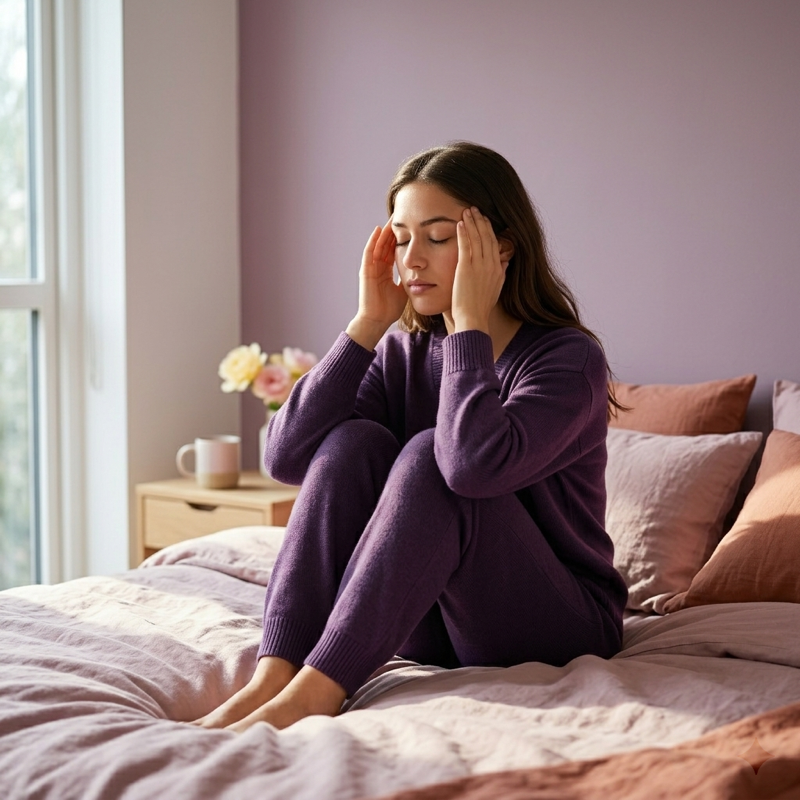
What you can do right now (5 minutes, wherever you are)
You do not need a quiet room. You do not need a mat. You do not need to be good at this.
Here is a simple breathing practice that works whether you are in bed, at your desk, or sitting in the car before walking into the house.
The 4-7-8 breath:
1. Sit or lie wherever you are. No special position needed. Your back does not need to be straight. Your eyes can be open or closed.
2. Breathe in through your nose for 4 counts. Slowly. Feel your belly rise, not your chest.
3. Hold gently for 7 counts. This is not about straining. If 7 feels too long, try 5.
4. Breathe out through your mouth for 8 counts. Let the exhale be slow and soft, like you are cooling a cup of chai.
5. Repeat 3 to 4 times. That is it. The whole thing takes under 5 minutes.
The long exhale helps engage your parasympathetic nervous system, the part of your body responsible for calming you down. Slow breathing at about 6 breaths a minute is linked with calmer heart-rate patterns and your body's rest-and-digest response.
You cannot do this wrong. If you lose count, start again. If your mind wanders, that is completely fine. It is supposed to.

It is okay to feel this way
Here is what nobody tells you about perimenopause anxiety: it does not mean you are broken. It does not mean you need to push through harder. It does not mean something terrible is about to happen.
Give yourself इजाज़त (permission) to pause.
You are allowed to sit in the car for 5 extra minutes before going inside. You are allowed to close the bathroom door and breathe. You are allowed to say "I need a moment" and mean it.

This is not weakness. This is the most practical thing you can do for yourself.
When to talk to your doctor
If your anxiety is severe, lasts for weeks, or stops you from doing things you normally do, please speak with your doctor. Breathing is a powerful daily support, but it is not a replacement for medical care. Hormone therapy, counselling, and other treatments can help alongside your breathing practice.
If a racing heart comes with chest pain, fainting or breathlessness, or if it does not settle, get urgent medical help. And if you ever have thoughts of harming yourself, contact local emergency services or a crisis helpline now.
You are not alone in this
The sudden onset of anxiety during perimenopause is one of the most common and least talked about experiences women go through. You are not the only one lying awake wondering what is happening to you.
If this feels familiar, you might also want to read about why menopause disrupts your sleep and what is actually happening with mood swings. They are all connected, and understanding that can help.
Start your first moment
Whenever the tightness comes, Sakhi is here. She will not tell you to calm down. She will breathe with you.
Talk to Sakhi, your free AI companion. Tell her how you feel and she will suggest a short breathing practice, a sleep story or some music for right now.
Or browse the library of short guided practices, most of them 5 minutes or less, made for women who do not have 30 minutes but do have 5.
5 minutes. No mat. No mantra. Just you.
Questions women ask
Is anxiety a normal part of perimenopause?+
Yes, it is common. Shifting oestrogen affects serotonin and GABA, the brain chemicals that help you feel calm and steady, so new or worsening anxiety can appear in perimenopause. You are not imagining it.
Can breathing exercises help perimenopause anxiety?+
They may. Slow breathing at about 6 breaths a minute is linked with calmer heart-rate patterns and the body's rest-and-digest response. Many women find a 5-minute daily practice helps them feel steadier.
How long does perimenopause anxiety last?+
It varies. For some women, anxiety eases within months. For others, it continues through the menopause transition. Daily breathing, movement and community support can help you feel steadier throughout.
What is the best breathing technique for anxiety at night?+
Many women like the 4-7-8 breath before sleep: in for 4, hold for 7, out for 8. The long exhale helps signal your nervous system to slow down, and you can do it lying in bed with your eyes closed.
Should I see a doctor for perimenopause anxiety?+
If your anxiety is severe, lasts several weeks, or interferes with daily life, yes. Breathing is a daily support, not a replacement for medical care. Your doctor can discuss options including counselling and hormone therapy.
Listen free, wherever you are