Night Sweats in Menopause: What Helps When You Wake Up Drenched at 3am
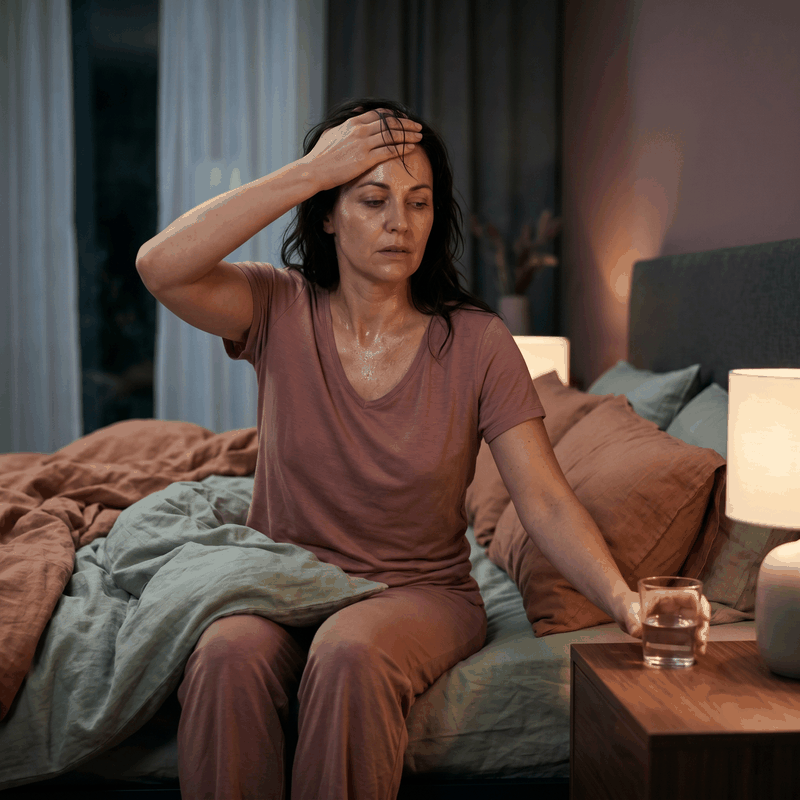
It's 3am and the sheet under you is damp. Your hair is stuck to your neck, your nightie is clinging, and the duvet you were huddled under an hour ago now feels like something you have to fight your way out of. Beside you, someone is snoring peacefully. You lie there wondering whether to get up, change, or just wait it out and hope sleep comes back.
You are not the only woman awake right now. Not even close.
In short: Night sweats are hot flushes that happen while you sleep, and around 3 in 4 women get hot flushes or night sweats during the menopause transition. What helps most in the moment is simple: cool your skin, change out of anything wet, then breathe slowly with a long exhale for about 5 minutes. For frequent night sweats, hormone therapy and CBT are options to discuss with a doctor.
Why do night sweats get worse at 3am?
During perimenopause, shifting hormone levels, especially oestrogen, make the part of your brain that manages temperature more jumpy. A tiny rise in body heat can set off a full cooling response: blood rushes to the skin, your heart speeds up, and you sweat. When that happens while you sleep, it is a night sweat.
Many women notice it most in the early hours. Sleep is lighter then, so you are more likely to wake fully when the heat arrives. And once you are awake at 3am, the mind joins in. The sweat turns into worry about tomorrow, about being tired, about whether this will ever stop.
It may help to know that this can be a long chapter. In the long-running US SWAN study, hot flushes lasted a median of about 7 years. That is not a reason to lose hope. It is a reason to have a plan for 3am that doesn't depend on willpower.
Night sweats in menopause: what helps first?
You don't need a perfect bedtime routine. You need a few small things within arm's reach, and a simple order to do them in.
Not this: lying rigid in damp sheets, scrolling your phone, checking the time every ten minutes. This instead: cool, dry, breathe, rest. In that order.
Try this now: a 5-minute bedside reset
You can't do this wrong. You don't have to leave the bed for most of it, and you don't need to switch on the big light.
- Cool your skin. Press a cool, damp cloth to your wrists, the back of your neck and your face for about a minute.
- Change what's wet. Swap into a dry top, or lay a towel over the damp patch, and flip your pillow to the cool side.
- Breathe out longer than you breathe in. Lie back, breathe in through your nose for 4 counts, then out through softly pursed lips for 6 to 8 counts, as if you are blowing on a cup of hot chai.
- Count ten slow breaths, then keep going. If you lose count, start again at one. Losing count is fine. It often means you are drifting.
- Let something else hold the dark. Press play on a short guided practice or soft music, or simply lie still. Don't check the time.
That long, slow exhale is the heart of it. Slow breathing at around 6 breaths a minute is linked with calmer heart-rate patterns and the body's "rest and digest" response, which is the opposite of the alarm state a night sweat leaves you in.
To be honest with you: breathing will not stop night sweats from happening. A larger 2013 trial of paced breathing found no clear drop in how often hot flushes happen. What many women do find is that it helps them feel calmer and more in control while one passes, and that can make the road back to sleep a little shorter.
What if you can't get back to sleep?
It's okay to be awake. Really. Lying in the dark and resting still counts for something, even if it doesn't feel like sleep.
If 20 minutes or so pass and you feel wide awake and frustrated, get up for a little while. Sit somewhere dim, sip some water, and come back to bed when you feel drowsy. If it's your mind racing rather than your body overheating, these breathing exercises for when you can't sleep at 2am are written for exactly that.
What if, tonight, the goal wasn't to sleep perfectly, but simply to be kind to yourself at 3am? As a didi might say, आराम से. Gently, no rush. Nothing has to be solved before sunrise.

Set up tonight so 3am is easier
A few minutes before bed can save you a lot of fumbling in the dark later.
- A glass of cool water and a folded cloth on your bedside table
- A spare cotton top or nightie within reach, so changing takes seconds
- Layers instead of one heavy duvet, so you can peel one off without waking fully
- A fan or an open window, if your home allows it
- One calming track ready to play, so you don't end up scrolling
In the MySakhi app there is even a small Circle called Cool Down, for women who know this feeling far too well. Sometimes it helps just to know others are awake too.
When should you see a doctor about night sweats?
Night sweats are common in perimenopause, but you don't have to simply put up with them. Talk to your doctor if they wake you most nights, leave you exhausted, or are affecting your mood or work. Hormone therapy (HRT, also called MHT) is the most effective treatment for hot flushes, including night sweats, for many women, and it is a conversation worth having with a doctor who knows your history. The UK's NICE menopause guidance also includes CBT as one option for night sweats and sleep problems.
See a doctor soon if your night sweats come with a fever, weight loss you can't explain, or you generally feel unwell, as these need checking for other causes.
Before your appointment, it can help to look through the full list of menopause symptoms, so you can tell your doctor about everything that is going on, not just the sweats.
You are allowed to make 3am easier
Night sweats are not a sign that you are doing something wrong. Your body is changing, and it is allowed to need a little extra care at night.
If you'd like something ready for tonight, talk to Sakhi. Tell her you've woken up drenched and she can suggest a practice, a sleep story or music for that exact moment. Or keep After the Wave saved for the next time 3am finds you.
5 minutes. No mat. No mantra. Just you.
Questions women ask
What helps night sweats in menopause straight away?+
Cool your skin with a damp cloth, change out of anything wet, flip your pillow, then breathe slowly with a longer exhale for about 5 minutes. Keeping water, a cloth and a spare top by the bed makes this much quicker.
Why do I get night sweats in perimenopause?+
Shifting hormone levels, especially oestrogen, make your brain's temperature control more sensitive. A small rise in body heat can trigger a full cooling response while you sleep, and that is a night sweat.
How long do menopause night sweats last?+
It varies a lot from woman to woman. In the US SWAN study, hot flushes lasted a median of about 7 years. Some women have them for a much shorter time, and some for longer.
Can breathing stop night sweats?+
Breathing is unlikely to stop them happening. A larger 2013 trial found no clear drop in how often hot flushes occur. Many women find slow breathing helps them feel calmer while one passes and settle back towards sleep.
When should I see a doctor about night sweats?+
If they wake you most nights, wear you out or affect your mood. See a doctor soon if they come with fever, weight loss you can't explain or feeling unwell. HRT and CBT are options to discuss.
Listen free, wherever you are