Can't Fall Asleep in Menopause? A 5-Minute Wind-Down for Bedtime
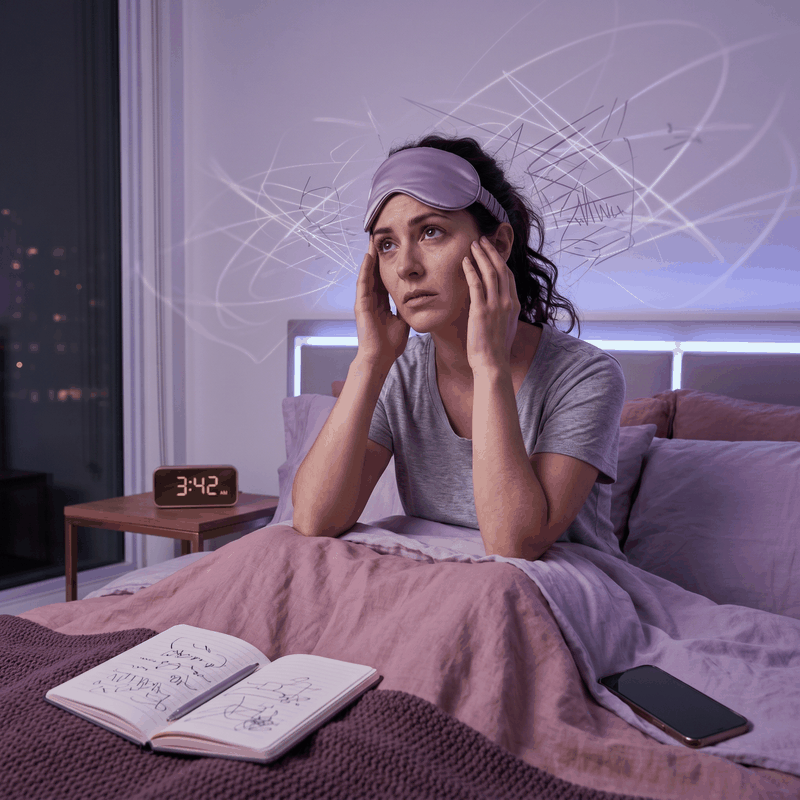
It's 11pm. The lights are off, the house has finally gone quiet, and you are so tired your eyes ache. But the moment your head touches the pillow, your brain switches on. That thing your sister-in-law said at lunch. The bill you forgot to pay. Whether you locked the back door. The duvet goes off, then back on. You check the clock: 11.40. Then 12.15.
Tired body. Wide-awake mind. If that's your bedtime, this one is for you.
In short: If you can't fall asleep in menopause, you're not doing anything wrong. Hormone shifts, night heat and a busy mind can all keep sleep away. A 5-minute wind-down can help: phone away, unclench your jaw, shoulders and hands, then four rounds of 4-7-8 breathing. If you struggle to fall asleep most nights for weeks, see a doctor, as CBT-I is the first-line treatment for long-term insomnia.
Why can't I fall asleep in menopause when I'm so tired?
This is the cruel bit: being exhausted doesn't guarantee sleep. To fall asleep, your body needs to feel safe enough to switch off, and in perimenopause several things get in the way.
Hormone changes can make sleep lighter and more fragile. A hot flush in the first hour can jolt you back awake just as you're drifting. And for many women, bedtime is the first quiet moment of the whole day, so every worry that had to wait finally gets its turn.
This post is about falling asleep in the first place. If you drop off fine but then wake at 2am, these breathing exercises for 2am waking are made for that. If you wake up drenched, try the night sweats reset instead.
Not more effort. Less.
Here's the thing nobody tells you. Sleep isn't something you can do harder. The more you try to force it, the more alert you become.
नींद को बुलाया नहीं जाता, उसे आने दिया जाता है। Sleep isn't summoned. It's allowed to arrive.
You don't need a perfect bedtime routine with candles and journalling. You need five minutes that tell your body: the day is over, and you're allowed to stop now.
Try this now: a 5-minute wind-down with 4-7-8 breathing
Do this lying in bed with the lights off. You can't do this wrong.
- Put the phone down for the night. Turn it face down, out of reach, or leave it across the room. Lights off.
- Unclench three places. Let your jaw soften so your teeth part. Let your shoulders drop away from your ears. Uncurl your hands.
- Breathe 4-7-8, four times. Breathe in through your nose for 4, hold gently for 7, then breathe out through your mouth for 8 with a soft whoosh.
- Let your breath go back to normal, with a long exhale. Stop counting. Just let every out-breath be a little slower than the in-breath.
- Let something else hold the night. Press play on soft music or a guided practice, or simply rest. If you're still awake, that's okay. You are resting.
If holding your breath for 7 feels uncomfortable, or makes your heart race, shorten it. Try in for 3, hold for 3, out for 5. The long exhale is what matters most. Slow breathing is linked with the body's "rest and digest" response, the state your body needs to be in before sleep can come.
The guided practice above is a little longer, about 10 minutes, for nights when you'd rather someone else did the counting.
What if my mind won't stop?
What if your thoughts aren't the enemy, just a to-do list with nowhere to go?
Before bed, try giving them somewhere to go. Keep a notebook by the bed and write down three things that are on your mind, plus one small thing you'll do about each tomorrow. Then close the notebook. When a thought comes back at midnight, you can tell it: you're written down, and I'll deal with you at 10am.
If a thought keeps looping, bring your attention back to the breath for one more round of 4-7-8. Losing count is a good sign. It usually means you're drifting.

Small things that make falling asleep easier
- A cooler bedroom, with layers you can kick off rather than one heavy duvet
- A wind-down that starts 30 minutes before bed: lights dimmer, screens away
- Tea or coffee earlier in the day, if you notice a late cup keeps you up
- The same rough bedtime most nights, so your body learns when to expect sleep
- Bedtime mode in the MySakhi app, if you'd like your night-time listening in one place
When it's more than a few bad nights
It's okay to ask for help with sleep. If you can't fall asleep most nights for several weeks, or it's affecting your mood, work or relationships, talk to your doctor. CBT for insomnia (CBT-I) is the first-line treatment for long-term insomnia, and the UK's NICE menopause guidance includes CBT as one option for sleep problems linked to menopause. Hormone therapy is another conversation to have with a doctor, especially if night heat is part of what keeps you awake.
If sleepless nights are bringing very low moods, or thoughts of harming yourself, please contact your local emergency services or a crisis helpline now. You don't have to carry that alone.
For a wider look at what's going on at night, this guide to menopause sleep problems goes deeper.
Tonight, just try the first step
Not a whole new routine. Just the phone face down and four slow breaths. That counts.
If you'd like something chosen for you, talk to Sakhi tonight. Tell her you can't fall asleep and she'll suggest a practice, a sleep story or music for that moment. You can also find MySakhi's sleep music on Spotify, including the album Deep Sleep Music 432Hz.
5 minutes. No mat. No mantra. Just you.
Questions women ask
Why can't I fall asleep in menopause even when I'm exhausted?+
Hormone changes can make sleep lighter, hot flushes can jolt you awake as you drift off, and bedtime is often the first quiet moment for worries. Being tired doesn't always mean your body feels ready to switch off.
What is 4-7-8 breathing?+
Breathe in through your nose for 4 counts, hold for 7, then breathe out through your mouth for 8. Four rounds is enough. If the hold feels uncomfortable, shorten it and keep the long exhale.
How long should a bedtime wind-down take?+
Five minutes is enough to start. Put your phone away, soften your jaw, shoulders and hands, and do four rounds of slow breathing. Dimming the lights 30 minutes before bed can help too.
When should I see a doctor about not being able to fall asleep?+
If you can't fall asleep most nights for several weeks, or it affects your mood or daily life. CBT-I is the first-line treatment for long-term insomnia, and HRT is a conversation to have with a doctor.
Does music help you fall asleep?+
It may. A 2022 Cochrane review found that listening to music may improve sleep quality for adults with insomnia. Choose something slow and calming that you enjoy.
Listen free, wherever you are