Menopause and Your Nervous System: Why Everything Feels Harder
You used to be the calm one. The one who could handle the school run, a work deadline and your father-in-law's hospital appointment all before lunch. Now a dropped spoon makes you jump. A slow queue at the chemist feels like an emergency. And when someone asks, "What's wrong?", you honestly don't know what to say, because nothing is wrong. Everything just feels harder.
You're not imagining it, and you haven't become a weaker person. There's a plain-words explanation, and one small thing you can do about it tonight.
In short: Menopause and your nervous system are connected through the symptoms you live with every day. Hot flushes, night sweats, broken sleep and mood changes can keep your body's stress response switched on more often, so small things feel huge. Slow breathing at about 6 breaths a minute is linked with calmer heart-rate patterns and the body's "rest and digest" response.
What is your nervous system actually doing?
Think of your nervous system as having two main settings.
- The stress response, often called fight or flight. Your heart speeds up, your breathing gets quick and shallow, your muscles tense. It's brilliant in a real emergency, like pulling a child back from the road.
- Rest and digest. Your heart slows, your breathing deepens, your body gets on with digesting, healing and sleeping.
A healthy system moves between the two all day. Something stressful happens, the stress response fires, and when it's over, you settle.
Picture a pressure cooker. The whistle is useful. It tells you the dal is done. But a cooker that whistles all day, with nobody turning down the flame, wears out everyone in the house. When the stress response barely switches off, that's how your body feels.
Why does menopause make everything feel harder?
Because your nervous system rarely gets the "all clear" right now.
A hot flush can feel like an alarm going off inside you: sudden heat, a racing heart, a wave of panic. Hot flushes and night sweats affect around 3 in 4 women. Night sweats and 3am wake-ups mean less sleep, and less sleep leaves you with less buffer for the next day's knocks. The long-running SWAN study also found the risk of depressive symptoms is 2 to 4 times higher during perimenopause.
Then there's the life around you. Ageing parents, children who still need you, work that doesn't pause for your hormones. सब कुछ ज़्यादा लगता है. Everything feels like too much, because you're carrying a lot on a body that's recalibrating.
It's okay that you can't carry things the way you used to, in the same way, at the same speed. That isn't failure. It's information.
If this tips into snapping at people, menopause rage and the 90 seconds before you snap may feel familiar. If it's noise and crowds that undo you, read overstimulated in midlife.
Can breathing really calm the menopause nervous system?
Breathing is one of the few parts of the stress response you can steer on purpose. When your out-breath is longer than your in-breath, and your pace slows to about 6 breaths a minute, that pattern is linked with calmer heart-rate patterns and the body's rest and digest response.
There's encouraging research too. In a 2023 Stanford study, people who did 5 minutes a day of cyclic sighing (two inhales through the nose, one long exhale through the mouth) for a month had better mood and a lower breathing rate. In that study it helped more than mindfulness meditation.
To be honest about it: breathing won't change your hormones or shrink your to-do list. What it can give you is a moment of choice, a small gap between the dropped spoon and the reaction. Which breathing technique helps which symptom compares a few options if you'd like to explore.
Try this now: the 10-second breath
Each breath takes about 10 seconds, which is roughly 6 breaths a minute. You can do this in an office chair, a parked car or sitting up in bed.
- Let something hold you. Sit back so a chair, car seat or headboard takes your weight. Feet flat if you can.
- Breathe in for 4. Softly, through your nose. Not a big gulp, just a full, easy breath.
- Breathe out for 6. Slowly, through your nose or through pursed lips, as if you're cooling a cup of tea.
- Repeat for up to 5 minutes. Count on your fingers if your mind wanders. It will wander, and that's fine.
- Notice one change. Your jaw, your shoulders, your hands. Whatever softened, even a little, counts.
If counting makes you more tense, drop the numbers. Just let each out-breath be a little longer than the in-breath. You can't do this wrong.
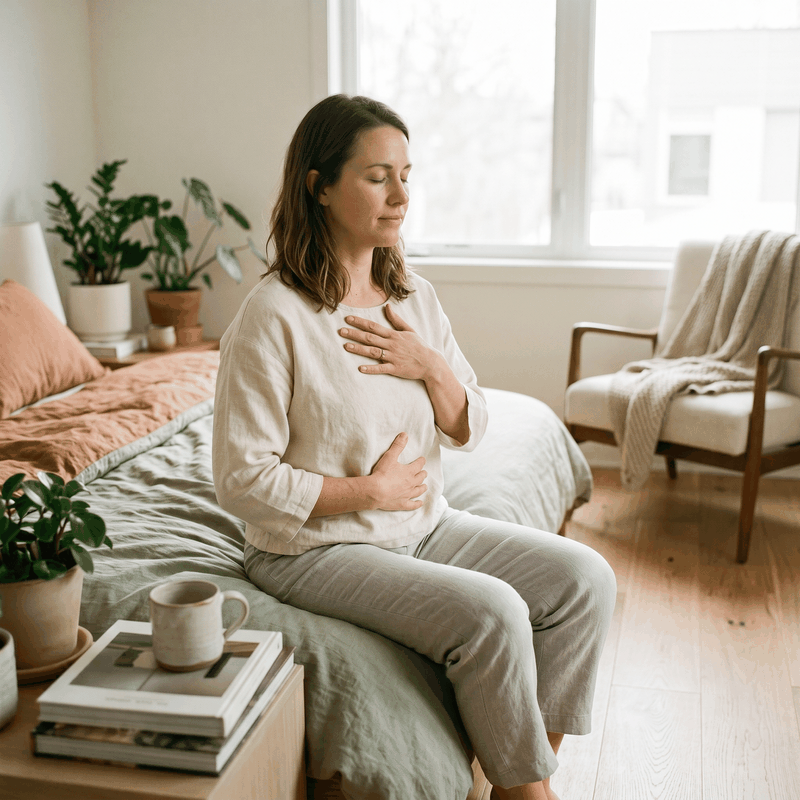
If you'd rather be guided, this practice keeps it to exactly that: one breath, right now.
When does your nervous system need more than breathing?
Breathing is support, not a replacement for care. Talk to your doctor if anxiety, a racing heart, poor sleep or low mood keeps coming back. The UK's NICE menopause guidance includes CBT as one option for hot flushes, night sweats, sleep problems and low mood linked to menopause, and hormone therapy is a conversation worth having too.
Some signs need help straight away. Chest pain, fainting, breathlessness, or palpitations that don't settle mean urgent care. Perimenopause palpitations explains more. If you have thoughts of harming yourself, contact your local emergency services or a crisis helpline now.
Small ways to give your body the "all clear"
You don't need a calmer life to start. You need one calmer minute inside the life you have.
- Run cool water over your wrists before you answer the next message.
- Turn off one notification you don't need.
- Step outside for two minutes and look at something far away.
- Say no to one thing this week, without a long explanation.
Not this: "I just need to toughen up." This instead: "My body is on high alert. Let me show it, for one minute, that it's safe."

What if the most useful thing you did today was simply stop for five minutes? Tell Sakhi how your day has felt, and she'll suggest a practice or some music for exactly this moment. Talk to Sakhi tonight.
5 minutes. No mat. No mantra. Just you.
Questions women ask
How does menopause affect the nervous system?+
Hot flushes, night sweats, broken sleep and mood changes can keep your stress response switched on more often. That can leave you jumpy, tired and quicker to feel overwhelmed.
Why do I feel so on edge in perimenopause?+
Your body may be getting fewer chances to settle, with poor sleep, hot flushes and a heavy life load all adding up. Feeling on edge is common, and it is worth talking to your doctor if it persists.
Does slow breathing calm the nervous system?+
Slow breathing at about 6 breaths a minute, with a longer out-breath, is linked with calmer heart-rate patterns and the body's rest and digest response.
What is the 10-second breath?+
Breathe in for 4 and out for 6, so each breath takes about 10 seconds. That is roughly 6 breaths a minute. Try it for up to 5 minutes, sitting or lying down.
When should I see a doctor about feeling anxious in menopause?+
See your doctor if anxiety, low mood or poor sleep keeps returning. Chest pain, fainting, breathlessness or palpitations that do not settle need urgent care.
Listen free, wherever you are