Best Breathing Technique for Menopause: Box, 4-7-8 or Cyclic Sighing?
At 11am a hot flush climbs up your neck in the middle of a meeting. At 4pm your heart is racing for no reason you can name. At 10pm your mind won't stop listing tomorrow. At 3am you're wide awake, staring at the ceiling fan. Four different moments, four different bodies, all in one day. No wonder "just breathe" can feel like useless advice.
Here's the thing: breathing isn't one tool. It's a small toolkit. And the breath that steadies you before a hard conversation is not the same breath that helps you drift back to sleep.
In short: There is no single best breathing technique for menopause, so match the breath to the moment. Cyclic sighing (two inhales, one long exhale) has the strongest evidence: a 2023 Stanford study found 5 minutes a day for a month improved mood. Slow breathing at about 6 breaths a minute suits hot flushes and a racing heart, box breathing suits focus, and 4-7-8 suits bedtime.
What makes a breathing technique the best one for menopause?
The best breath for you depends on three things: what's happening in your body right now, where you are, and what feels okay. A technique with long breath holds might be lovely at bedtime and awful in the middle of a hot flush. A technique you can do silently at your desk matters more at work than one that needs you to lie down.
Most calming breaths share one thing: a slower pace, often with a longer out-breath. Slow breathing at about 6 breaths a minute is linked with calmer heart-rate patterns and the body's "rest and digest" response. Beyond that, each technique has its own strengths. Below, each one gets its own section: what it is, how to do it, and the moments it suits best.
A few ground rules for all of them. Breathe gently and never force it. If you feel dizzy or light-headed, stop and breathe normally. If holds feel uncomfortable, skip them. You can't do any of these wrong. 5 minutes is enough, and even one minute counts.
Cyclic sighing: the breath with the strongest evidence
What it is: two inhales through the nose (a full breath, then a short extra sip of air on top), followed by one long, slow exhale through the mouth. It's a deliberate, gentle version of the sigh your body does on its own when it's letting go.
Why it stands out: in a 2023 study from Stanford (Balban and colleagues, published in Cell Reports Medicine), people who did 5 minutes of cyclic sighing a day for a month had better mood and a slower breathing rate. In that study, it helped more than mindfulness meditation did. That's a meaningful result for something that takes 5 minutes and no equipment.
How to do it:
- Sit or lie comfortably and let your shoulders drop.
- Breathe in through your nose until your lungs feel comfortably full.
- Take one more short sip of air through your nose, right on top.
- Breathe out slowly through your mouth, for as long as is comfortable, until you feel empty.
- Repeat at an easy pace for up to 5 minutes.
Best for: low mood, a heavy or tight chest, daytime anxiety, and the general frazzled feeling of perimenopause. It's also a good everyday reset to do once a day, whether or not you feel stressed.
Slow paced breathing: about 6 breaths a minute
What it is: breathing in for a count of 4 and out for a count of 6, which works out at roughly 6 breaths a minute. No holds. Simple, and quiet enough to do anywhere.
How to do it:
- Breathe in gently through your nose for a count of 4.
- Breathe out softly through your nose or mouth for a count of 6.
- Keep going for 3 to 5 minutes. If 4 and 6 feel too long, try 3 and 5.
Best for: hot flushes, racing-heart moments and anxious afternoons. An honest word on hot flushes: early small studies of paced breathing were promising, but a larger 2013 trial found no clear drop in how often hot flushes happen. So it isn't a way to stop them. What many women do find is that it helps them feel calmer and more in control while one passes, and that matters. Our post on 5-minute breathing for hot flashes goes deeper.
If your heart races or flutters often, see your doctor to check what's going on. Chest pain, fainting, breathlessness, or palpitations that don't settle mean urgent care.
Box breathing: the steadying breath
What it is: four equal sides. In for 4, hold for 4, out for 4, hold for 4, like tracing the edges of a square.
How to do it:
- Breathe in through your nose for a count of 4.
- Hold gently for 4.
- Breathe out for 4.
- Hold, empty, for 4.
- Repeat for 2 to 5 minutes.
Best for: moments when you need to feel steady and clear-headed rather than sleepy. Before a difficult phone call, in the car before a meeting, or when a to-do list has you spinning. The counting gives a busy mind something to hold onto.
Less good for: the peak of a hot flush or a pounding heart, when holding your breath may feel uncomfortable. In those moments, choose slow paced breathing instead, or simply drop the holds.
4-7-8 breathing: the bedtime breath
What it is: in through the nose for 4, hold for 7, out through the mouth for 8 with a soft whoosh. The long hold and very long exhale make it deeply slowing.
How to do it:
- Rest the tip of your tongue just behind your top front teeth.
- Breathe in quietly through your nose for a count of 4.
- Hold for 7.
- Breathe out through your mouth for 8, with a gentle whooshing sound.
- Do 4 rounds to start. That's enough.
Best for: winding down in bed, falling asleep, and the mind that won't switch off at night. If the counts feel too long, keep the same pattern but count faster, or skip the hold. Our post on what to do when you can't sleep at 2am has more for the middle of the night.

Belly breathing: the foundation
What it is: letting your belly, rather than your chest, rise as you breathe in and fall as you breathe out. It's how babies breathe, and how many of us stopped breathing somewhere around our teens.
How to do it:
- Put one hand on your chest and one on your belly.
- Breathe in through your nose and let the belly hand rise while the chest hand stays fairly still.
- Breathe out slowly and feel your belly fall.
- Keep going for 3 to 5 minutes.
Best for: beginners, bloating, pelvic floor support, and as the base for every other breath here. If your tummy feels tight and uncomfortable, our practice for menopause bloating walks you through it, and pelvic floor breathing builds on it.
Cooling breath: for heat that won't wait
What it is: breathing in through a curled tongue, or through gently closed teeth, and out through the nose. In Indian tradition it's called sheetali, from शीतल, which means cool.
How to do it:
- Curl the sides of your tongue into a tube and let it poke out slightly. If you can't curl it (lots of people can't), part your lips and breathe in through gently closed teeth instead.
- Breathe in slowly and feel the cool air across your tongue.
- Close your mouth and breathe out slowly through your nose.
- Repeat for 1 to 3 minutes.
Best for: the moment heat rises, whether from a hot flush or from anger. Many women find the cool air on the tongue soothing. As with paced breathing, think of it as a way to feel calmer and more in control, not as something that stops the flush.

Which breath for which moment: a quick guide
Not a rulebook. Just a starting point. Save this list on your phone for the moment you need it:
- Hot flush rising: slow paced breathing (in 4, out 6) or cooling breath, with no holds
- Racing or fluttering heart, once a doctor has checked it: slow paced breathing
- Low mood or a heavy chest: cyclic sighing for 5 minutes
- Daytime anxiety: cyclic sighing or slow paced breathing
- Before a hard conversation or meeting: box breathing
- Overstimulated and snappy: long exhales, in for 4 and out for 8
- Can't fall asleep: 4-7-8 for 4 rounds, then let your breath go natural
- Awake at 3am: slow paced breathing, eyes closed, no clock-watching
- Bloated or tight belly: belly breathing, lying down
- Rage heat: cooling breath, then slow paced breathing
- Just starting out: belly breathing for 2 minutes a day
What breathing can't do
Breathing is a lovely, free, always-with-you tool. It isn't the whole answer, and it's okay to want more help.
Hormone therapy (HRT, also called MHT) is the most effective treatment for hot flushes for many women. Whether it suits you is a conversation to have with your doctor. The UK's NICE menopause guidance also includes CBT as one option for hot flushes, night sweats, sleep problems and low mood linked to menopause. And if you've had trouble sleeping for months, CBT for insomnia (CBT-I) is the first-line treatment.
Please talk to a doctor if symptoms are affecting your daily life, if your mood stays low, or if anything feels new and worrying. If you ever have thoughts of harming yourself, contact your local emergency services or a crisis helpline now.
How to start without overthinking it
You don't need to learn all six today. You need one.
Pick the moment that troubles you most: nights, heat, mood or nerves. Choose its breath from the list above. Try it once today and once tomorrow. That's it. Not a 30-day challenge. Not a perfect streak. Just one breath you know you can reach for.
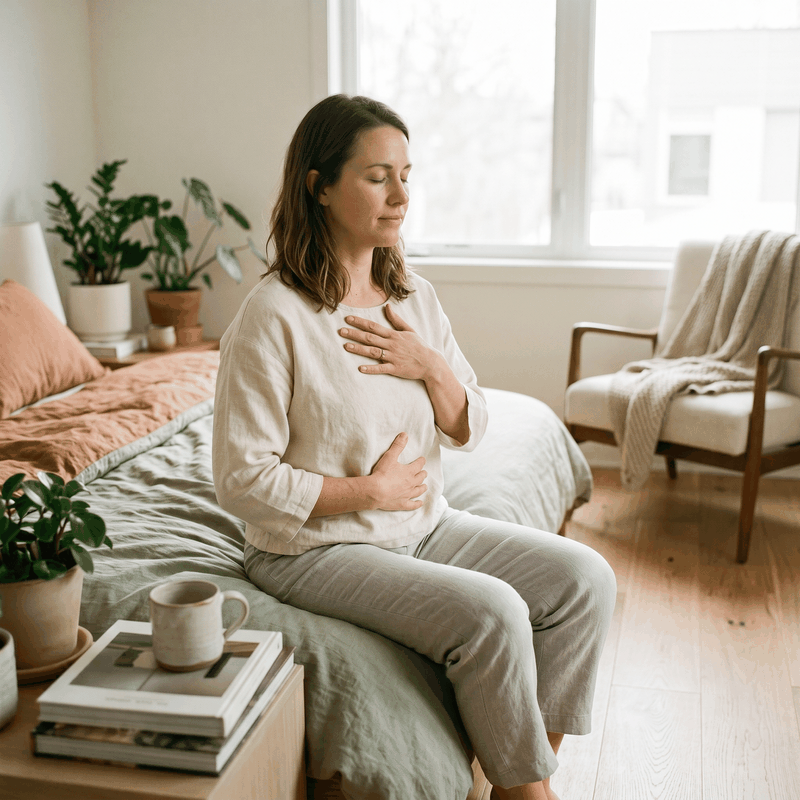
What if the next hard moment came and, instead of white-knuckling through it, you had something to do: a hand on your chest and a breath slowing down? That's not nothing. That counts.
If you're not sure where to begin, tell Sakhi what you're feeling right now and she'll suggest a guided breathing practice for that moment. You can also browse every practice in the MySakhi library, or see how all of this fits together in our full list of menopause symptoms.
5 minutes. No mat. No mantra. Just you.
Questions women ask
What is the best breathing technique for menopause?+
There's no single best one. Cyclic sighing has the strongest evidence for mood, slow breathing at about 6 breaths a minute suits hot flushes and a racing heart, box breathing helps focus, and 4-7-8 helps at bedtime.
Is box breathing or 4-7-8 better for sleep?+
4-7-8 is usually the better choice at bedtime because its long hold and long exhale are very slowing. Box breathing suits moments when you need to feel steady and alert, like before a meeting.
What is cyclic sighing?+
Cyclic sighing is two inhales through the nose followed by one long exhale through the mouth. A 2023 Stanford study found 5 minutes a day for a month improved mood, more than mindfulness meditation did in that study.
Can breathing exercises stop hot flushes?+
Breathing isn't proven to stop hot flushes. A larger 2013 trial found paced breathing didn't clearly reduce how often they happen, but many women find it helps them feel calmer while one passes. Talk to a doctor about treatment options.
How long should I do breathing exercises each day?+
5 minutes a day is a good amount to start with, and even one minute counts. In the Stanford study, 5 minutes of cyclic sighing a day for a month was enough to improve mood.
Listen free, wherever you are