What Is 432Hz Music for Sleep? An Honest Guide for Women Who Lie Awake
It's 1.40am. The house is quiet, your mind is not, and you have just typed "432Hz music for sleep" into your phone because someone in a group chat swore by it. Now you are reading about healing frequencies and the vibration of the universe, and you feel more awake than when you started.
Let's slow this down together. You deserve a straight answer, not a sales pitch.
In short: 432Hz music is music tuned so the note A vibrates 432 times a second instead of the usual 440. Evidence for 432Hz specifically is limited: one small 2019 study found a slightly lower heart rate with 432Hz music than with 440Hz. Calming music in general may improve sleep for adults with insomnia. What matters most is whether a sound calms you.
What does 432Hz actually mean?
Every musical note is a vibration. To tune an instrument, you pick one reference note and tune everything else around it. Most modern music uses A at 440Hz, which means the string or the air vibrates 440 times every second. 432Hz tuning lowers that reference a little, to 432 vibrations a second.
That is the whole of it. A 432Hz track is not a different kind of music. It is the same notes, sitting very slightly lower. If you heard the same melody in both tunings one after the other, you might struggle to tell them apart. Some listeners say 432Hz feels a touch warmer or rounder. Others notice nothing at all. Both are completely normal.
Why do people say 432Hz music helps you sleep?
Search for 432Hz and you will find big promises: that it repairs the body, matches the heartbeat of the earth or heals you at a cellular level. None of that is backed by good evidence, and you do not need it to be true for music to help you rest.
Here is what is more likely going on. Music made for sleep, in any tuning, tends to be slow, soft and steady. It has no lyrics pulling at your attention, no sudden drum hits, no chorus that makes you want to sing along. When a calm track happens to be labelled 432Hz, much of the calm may be coming from everything else about it.
That is not a reason to dismiss it. It is a reason to stop worrying about whether you have found the "right" frequency. You can't get this wrong.
What does the research say about 432Hz music for sleep?
Honestly, not much yet. The research on 432Hz specifically is thin. One small study in 2019 compared music tuned to 432Hz with the same music tuned to 440Hz and found a slightly lower heart rate with the 432Hz version. It was small, and one study is a beginning, not a conclusion.
The wider picture on music and sleep is more encouraging. A 2022 Cochrane review, which pools the results of many trials, found that listening to music may improve sleep quality for adults with insomnia. Those trials were about calming music in general, not about 432Hz.
So the honest summary looks like this:
- Calming music may help many adults sleep better.
- 432Hz tuning might add a small difference, or it might not. Nobody knows yet.
- The sound that settles your body is the right one for you, whatever its tuning.
Not this: hunting for a magic frequency at 2am. This instead: pressing play on something soft and letting your breath follow it.
Why is all MySakhi music tuned to 432Hz?
Every original track in the MySakhi library is tuned to 432Hz and built on an Indian raga. That is a choice about feel. It gives the whole library one soft, consistent sound, so moving from one track to the next never jolts you.
It is not a medical promise. Nobody should tell you a frequency will fix your sleep. What you can count on is that each track was made to be slow, steady and free of surprises, so your nervous system has nothing to brace against.
Why does sleep get so hard in perimenopause and menopause?
If you slept well for years and now you don't, you are not imagining it. Hot flushes and night sweats affect around 3 in 4 women, and they love the middle of the night. Many women also wake at 3am with a racing mind, a thudding heart or a to-do list that suddenly feels urgent. Perimenopause lasts about 4 years on average, and for some women much longer, so this is not something you should have to grit your teeth through alone.
Music will not change your hormones. What it may do is give your mind something gentle to hold while your body settles, instead of the glow of your phone or the loop of tomorrow's worries. If night sweats are what wake you, the 5-minute night sweat reset pairs well with any of the tracks below.
Try this now: a 5-minute 432Hz listening practice
You don't need a perfect bedroom or a special speaker. You need one track, a low volume and five minutes. This works lying in bed, sitting in the car before you go inside, or on the bathroom floor at 3am.
- Press play on one calm track at the lowest volume you can still hear, and put the phone face down.
- Let your eyes close and find the lowest sound you can hear in the music.
- Breathe in through your nose for a slow count of four, then out through your mouth for a count of six. That is roughly six breaths a minute.
- When your mind wanders, return to that low sound. Wandering is not failing. Coming back is the practice.
- For the last minute, take two short inhales through the nose and one long sigh out through the mouth, a few times over.
That last step is called cyclic sighing. In a 2023 Stanford study, 5 minutes a day of it for a month improved mood and lowered breathing rate. It is a lovely way to end, and it asks nothing of you except a long, slow exhale.
It's okay if you fall asleep before the track ends. That counts. It's also okay if you don't. Five minutes of lying still with soft sound is still rest.
Which MySakhi tracks should you try first?
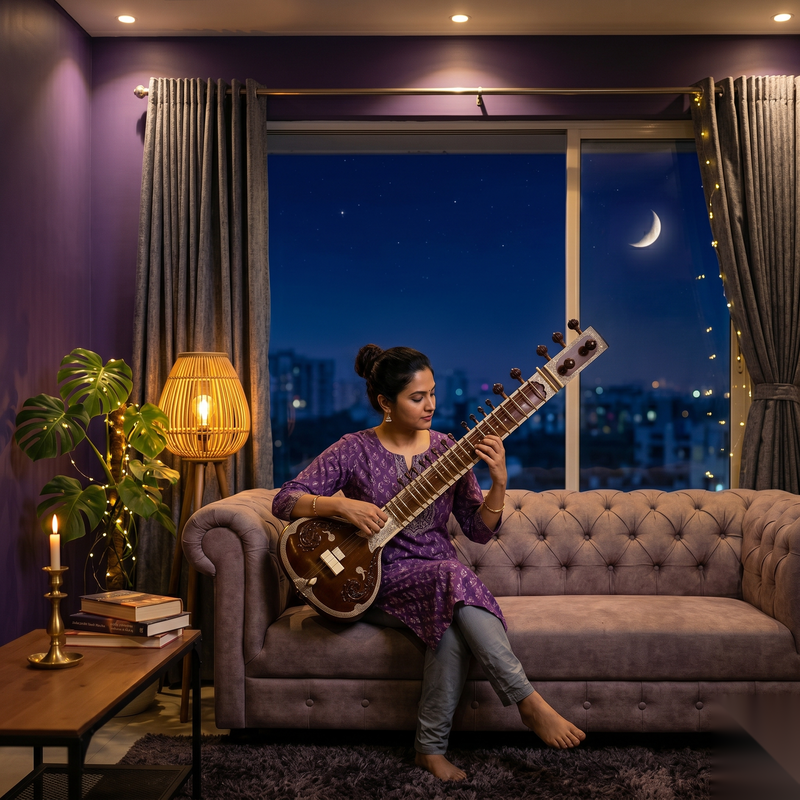
If you want somewhere to begin, start with "Midnight Knows Your Name." It is built on Raga Malkauns, a raga that tradition links with the deep middle of the night, over a low tanpura drone, and it runs about five minutes. It was made for exactly the moment you are awake and wish you weren't.
Raga time theory, the idea that certain ragas belong to certain hours, is tradition and lived experience rather than proven science. Still, there is something comforting about music that was imagined for the hour you are in.
A few more to try:
- "Follow The Night River." Raga Bageshri, carried by the dilruba, a bowed string with a soft, singing tone. Made for restless nights and broken sleep.
- "The River Moves At Night." Also Bageshri, this time with the deeper voice of the sarod. Good when worry is what keeps you up.
- "Night Fell. She Was Ready." Raga Yaman with sarod, a little over six minutes, for winding down before the lights go off.

If you would like a full running order for your night, from wind-down to the 3am wake-up, the sleep music playlist for women over 40 lays it out. And if the evening ragas speak to you, evening ragas for sleep goes deeper into Yaman, Bageshri and Malkauns.
How do you make sleep music work for you?
A few small choices can make a real difference:
- Keep it low. Music should sit in the background like rain on a window, not fill the room.
- Use the same track for a while. Repetition is soothing. Over a week or two, a familiar track can become a cue that tells your body it is time to rest.
- Choose longer versions for the whole night. Each MySakhi track also comes in a 20-minute and a 1-hour version, so you are not woken by sudden silence when a short track ends.
- Skip lyrics at bedtime. Words invite your thinking brain to join in.
- Set a sleep timer. Most phones let you stop playback after 30 or 60 minutes.
What if the point isn't to force sleep at all? What if it is simply to make the dark feel a little less lonely? Think of it as a लोरी, a lullaby, for the grown woman who still needs one.
Where can you listen to MySakhi music?
MySakhi is a free app for women in perimenopause and menopause, with short guided breathing practices, sleep stories, calming 432Hz music and Sakhi, an AI companion who suggests what might help tonight. The app is free to download on the App Store, and on any phone you can listen free in the MySakhi library.
You will also find the music under the artist name MySakhi on Spotify, and on Apple Music and Amazon Music if you search MySakhi. For whole-night listening, the MySakhi YouTube channel has the 20-minute and 1-hour versions. The albums Deep Sleep Music 432Hz and Music for Anxious Hours 432Hz are gentle places to start. Every platform is listed in where to listen to MySakhi music.
Not sure which track fits tonight? Tell Sakhi how you feel, whether that is hot and restless or wide awake and worried, and she will suggest something for that moment.
When is it more than a bad night?
Music is a comfort, not a cure. If you have been sleeping badly for weeks, please talk to your doctor. CBT for insomnia (CBT-I) is the first-line treatment for long-term insomnia, and the UK's NICE menopause guidance includes CBT as one option for sleep problems, hot flushes and low mood linked to menopause. If night sweats are what keep waking you, hormone therapy is also a conversation worth having with your doctor.
If low mood is sitting heavily on you, or you have any thoughts of harming yourself, please contact your local emergency services or a crisis helpline now. You do not have to hold that alone.
For everything else that may be changing in your body right now, the full list of menopause symptoms is a gentle place to look.
Let tonight be simple
You don't need to understand frequencies to rest. You need permission to stop trying so hard. Tonight, choose one track, turn it down low and give it five minutes. If sleep comes, wonderful. If it doesn't, you have still given your body something kind.
Press play on Midnight Knows Your Name tonight, and let the music do the holding for a while.
5 minutes. No mat. No mantra. Just you.
Questions women ask
Does 432Hz music really help you sleep?+
Evidence for 432Hz specifically is limited. One small 2019 study found a slightly lower heart rate with 432Hz music than with 440Hz. Calming music in general may improve sleep quality, so choose the sound that relaxes you.
What is the difference between 432Hz and 440Hz music?+
It is the tuning. In 440Hz music the note A vibrates 440 times a second; in 432Hz music it vibrates 432 times, so every note sits very slightly lower. Some listeners find it warmer, others hear no difference.
Is it okay to fall asleep listening to music every night?+
For most women, yes. Keep the volume low, choose slow music without lyrics or sudden changes, and use a sleep timer or a longer version so a sudden silence does not wake you.
Where can I find 432Hz sleep music by MySakhi?+
MySakhi's original 432Hz music, built on Indian ragas, is free in the MySakhi app and at mysakhi.life, on Spotify under the artist MySakhi, on YouTube in 20-minute and 1-hour versions, and on Apple Music if you search MySakhi.
Can music help with menopause insomnia?+
Music may help you relax, and a 2022 Cochrane review found it may improve sleep quality for adults with insomnia. If poor sleep lasts for weeks, talk to your doctor: CBT-I is the first-line treatment for long-term insomnia.
Listen free, wherever you are