Midlife Wellness for Women: Not a Crisis, a Permission to Do Less
If you have ever opened a wellness app and felt it was made for a 22-year-old with three free hours a day and nobody depending on her, this one is for you.
In short: Midlife women's wellness is not a diet, a 5am routine or a supplement stack. It is sleep that lets you repair, a nervous system that can switch off, focus that returns, and a life you still recognise. Five minutes of slow breathing a day, at about 6 breaths a minute, is a realistic place to start.
ये आपके लिए है। बैठिए, साँस लीजिए, पढ़िए।
Is midlife really a crisis?
Somewhere along the way, "midlife crisis" stopped meaning a man buying a sports car and started being used for any woman over 40 who was tired. Tired of saying yes. Tired of sleeping at 11 and waking at 3. Tired of being the emotional thermostat for a whole family.
It is not a crisis. It is a transition. Perimenopause and menopause are not failures of discipline. They are a real biological shift. Hot flushes and night sweats affect around 3 in 4 women. By 2030, an estimated 1.2 billion women worldwide will be menopausal or postmenopausal. The experience is not rare. The only crisis is that so many women are still told to push through it with a green smoothie and a gratitude journal.
If your forties or fifties feel louder than your twenties ever did, the reason is not you. Your body is changing, exactly as bodies do. You are allowed to respond to it instead of pretending it is not happening.
What does wellness actually mean for a woman in midlife?
It is not performance. It is not a morning routine with 14 steps. Wellness in midlife comes down to four quiet things.
One: sleep that lets your body repair. Not perfect sleep. Enough sleep. Which in perimenopause often means getting back to sleep at 3am without reaching for the phone.
Two: a nervous system that is not stuck on. A heart that settles when you sit. A jaw that is not clenched before breakfast.
Three: focus that returns. Finishing a sentence without walking into a room and forgetting why. Reading without rereading.
Four: a life you recognise. Time in your day that belongs to you. A body you can still feel at home in, even while it changes.
Everything else, the workout plans, the supplements, the 45-minute morning flows, is optional. Most of it will not survive a real life. These four will.
Why is 5 minutes the right amount?
The wellness industry has a problem with size. Hour-long classes, 30-day challenges, 10,000 steps, all expected of a tired woman with teenagers, a job and ageing parents. She cannot find the time. She gives up. Then she feels guilty.
Five minutes works for three reasons.
It is short enough to actually do. A small practice you return to beats a big one you abandon after twice.
Your body responds inside that window. Slow breathing at about 6 breaths a minute is linked with calmer heart-rate patterns and the body's "rest and digest" response. A 2023 Stanford study found that 5 minutes a day of cyclic sighing for a month improved mood, more than mindfulness meditation did.
It fits the gaps you already have. The car after you park. The kitchen before the kettle boils. The bed, before sleep. You don't need a new hour. You need five minutes you already have.
For the symptom-by-symptom version, read the complete guide to breathing exercises for menopause.
You cannot do this wrong. If your mind wanders, keep breathing. The slow exhale is the practice, not the empty mind.

Why is it so hard to give ourselves permission?
Most women in midlife do not have a time problem. They have a permission problem.
She could find 5 minutes. She could close the bedroom door. But somewhere along the way, as mother, wife, daughter, colleague, friend, she learned that stopping is indulgent. That rest has to be earned. That doing nothing is only acceptable once everyone else is fine.
Many of us were raised by women who held everything together and fell apart quietly, or not at all. Permission is a new skill. It does not feel natural. It feels like cheating. It is not.
It is okay to sit down. It is okay not to finish the washing tonight. It is okay to say "not right now". You are not being selfish. You are being human.
आपको इजाज़त है। ये ज़रूरी है।
If the guilt is heavy, read the guilt of taking 5 minutes for yourself next.
What should I stop doing?
A surprising amount of midlife wellness is subtraction, not addition.
- Stop waking up to the phone. Five minutes of slow breathing before the messages, not after, changes the shape of a morning.
- Stop explaining your no. "I won't be able to" is a full sentence. The explanation is how guilt refills.
- Stop calling rest lazy. Rest is something your body needs. "Lazy" is a word used to shame people into doing more than they can.
- Stop apologising for perimenopause. Brain fog is not incompetence. You do not owe anyone a polished version of yourself while you cross through this.
- Stop comparing your midlife to someone else's feed. The person posting green juice at 5am is not your reference point. You are.
What should I start doing?
Keep it to three.
- Five minutes of slow breathing, daily. Pick the symptom that bothers you most and breathe for it.
- One boundary a week. Not ten. One you actually hold. It will feel strange. Hold it anyway.
- One space that is only yours. A corner of the bedroom. A chair by the window. Somewhere your body learns means "now I stop".
That is the whole plan. One practice. One boundary. One space.
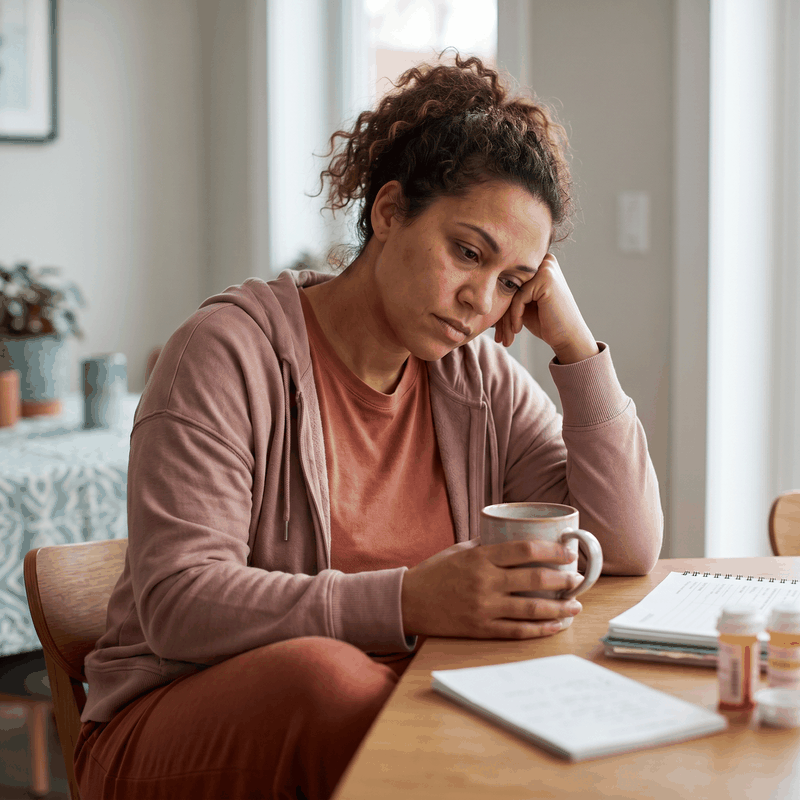
Doing less, better
The point of midlife wellness is not to add a routine to a life that is already too full. Not this: more. This instead: less, better. Less scrolling, better rest. Less explaining, better boundaries. Less perfection, better presence.
What if your forties and fifties became your most grounded decades? Not because life gets easier, but because you finally stop pretending it is supposed to be. For the life-stage view, perimenopause is not a diagnosis, it is a transition.
And if your symptoms are affecting your sleep, work or mood, please talk to your doctor. Wellness and medical care work best side by side.
Start your first moment
You do not need to read any more. Choose one thing. Sit down for 5 minutes. Breathe slowly, with the out-breath longer than the in-breath.
If you would like a voice to guide you, press play in the MySakhi library, or tell Sakhi how you are really doing. She is free, she speaks English and Hindi, and she will suggest one small thing for tonight.
5 minutes. No mat. No mantra. Just you.
Questions women ask
What does midlife wellness actually mean for women?+
It means sleep that lets your body repair, a nervous system that can switch off, focus that returns and a life you still recognise. It is not a 5am routine or a supplement stack.
Is midlife really a crisis for women?+
No. Midlife often overlaps with perimenopause and menopause, a real biological transition. Hot flushes and night sweats affect around 3 in 4 women. It is a change to respond to, not a personal failure.
How much time do I need for midlife wellness?+
Five minutes a day is a realistic start. A 2023 Stanford study found 5 minutes a day of cyclic sighing for a month improved mood. Returning to it regularly matters more than doing it for long.
Why do women over 40 feel guilty about resting?+
Many women were raised by women who never had permission to rest, so the guilt is learned rather than personal. Naming it out loud, then resting anyway, often helps it soften over time.
Is this a replacement for HRT, medication or therapy?+
No. Breathing, boundaries and rest are wellness support, not medical treatment. If you are considering HRT or your symptoms are severe, please talk to your doctor.
Listen free, wherever you are