Menopause Hair Thinning: Making Peace With the Woman in the Mirror
You pull the comb through your hair in the morning and it comes away with more strands than it used to. You gather them from the bathroom floor, from your pillow, from the drain. Your plait was once as thick as your wrist. Now, in the harsh light of the lift mirror, your parting looks wider than you remember, and the skin on your cheeks looks thinner and drier, somehow less yours.
You might feel silly for minding. Other people have bigger problems, you tell yourself. But you do mind. And that is allowed.
In short: Menopause hair thinning is common. As oestrogen falls, many women notice their hair becoming finer and sparser, especially along the parting, while skin becomes drier, thinner and less springy. These changes are usually gradual. Sudden, patchy or heavy hair loss should be checked by a doctor or dermatologist. Feeling sad about it is allowed, and gentle care, including 5 minutes of kind breathing, may help you feel more at peace.
Why does hair thin during menopause?
Oestrogen helps keep hair in its growing phase for longer. As levels fall through perimenopause and after menopause, many women find their hair grows more slowly, sheds more and becomes finer. The balance between oestrogen and other hormones shifts too, which can affect the hair on your head and sometimes bring a few stray hairs to the chin.
Other things can add to it: stress, illness, low iron, thyroid changes, crash diets and some medicines. That's one reason it's worth a conversation with a doctor if the change feels big or fast.
What happens to your skin in menopause?
Oestrogen also helps your skin hold moisture and stay plump and springy. As it falls, many women notice their skin feels drier, thinner, itchier or more sensitive. Fine lines may appear faster. Products you've used for years might suddenly sting, or stop doing what they used to.
None of this means you are doing anything wrong, or that you've let yourself go. It means your body is changing, as bodies do.
It's okay to grieve the old reflection
Here's something nobody tells you: it is okay to feel grief about this. Not vanity. Grief. You've known that face and that hair for decades. They were part of how you recognised yourself. Watching them change can feel like losing a small piece of who you were.
You don't need to pretend you don't care. You need room to feel it, and then a way to be kind to the woman looking back at you.
Not this: standing under a bright bulb, cataloguing every change in your parting. This instead: looking into your own eyes for a moment, the way a friend would.
What if the woman in the mirror isn't a problem to be fixed, but someone who deserves the same tenderness you give everyone else?
Try this now: a 5-minute mirror moment
- Stand or sit in front of a mirror in soft light, not the harshest bulb in the house.
- Look at your eyes, not your hairline or your skin. Just your eyes, for three slow breaths.
- Rest one palm gently on your cheek. Breathe in through your nose for a count of 4, and out through your mouth for a count of 6.
- Say one true, kind sentence to yourself, out loud or silently: "You have carried so much. I see you."
- If you like, warm a little oil between your palms and slowly massage your scalp with your fingertips, like a champi (चंपी) from your mother or grandmother. Not to fix anything. Just to be cared for.
- Take one last breath, let your shoulders drop, and then walk away.
There's no right way to do this, and if tears come, let them. That counts too.
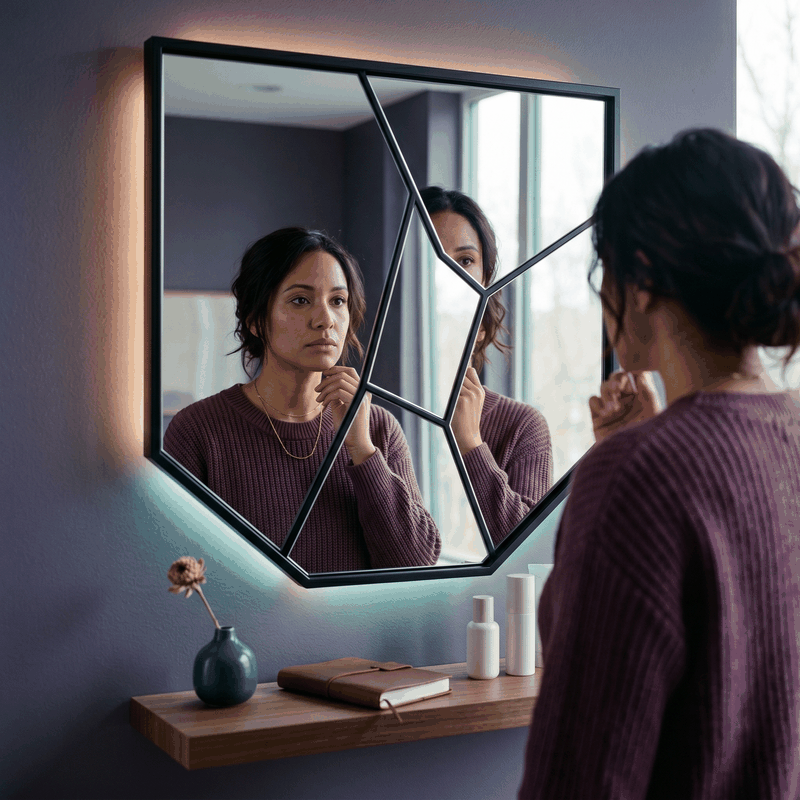
The Woman in the Mirror is a 5-minute guided meditation made for this exact feeling. You can play it right here, any morning before you face the mirror.
How can you care for thinning hair and changing skin?
You don't need a twelve-step routine or an expensive overhaul. Small, kind things tend to feel better:
- Be gentle with wet hair. Use a wide-toothed comb, and go easy on tight buns, clips and high heat.
- Choose a gentle cleanser and a richer moisturiser if your skin feels tight or dry.
- Wear sunscreen on your face and hands.
- Eat regular, nourishing meals rather than crash dieting.
- Protect your sleep where you can, and give stress somewhere to go, even 5 minutes a day.
And try not to compare your hair with a twenty-year-old's in an advert. That was never a fair comparison.
When should you see a doctor about hair loss?
See a doctor or dermatologist if:
- your hair loss is sudden, heavy or happening in patches
- you have bald spots, or a sore, itchy or scaly scalp
- hair loss comes with tiredness, feeling cold, weight changes or very heavy periods
- you've recently started a new medicine and noticed more shedding
- your skin has a rash, sores or changes that won't heal
A doctor may suggest blood tests, for example to check your iron or thyroid, and can talk through treatment options with you. It's okay to ask, even if it feels small. If it matters to you, it matters.
The woman you are now
Your body is not a before-and-after picture. It's a life, still being lived. The finer plait and the new lines sit alongside everything you've carried, everyone you've held, and all the years you've kept going.
It's okay to miss how you used to look. It's also okay to slowly, gently, begin to like who's looking back.
If you've been feeling unsure about your body in other ways, our post on body image after 40 is a warm place to land, and our full list of menopause symptoms explains the other changes you might be noticing. For the days your body feels like a stranger's, This Body Is Still Yours is a 5-minute guided meditation, free in the MySakhi library.
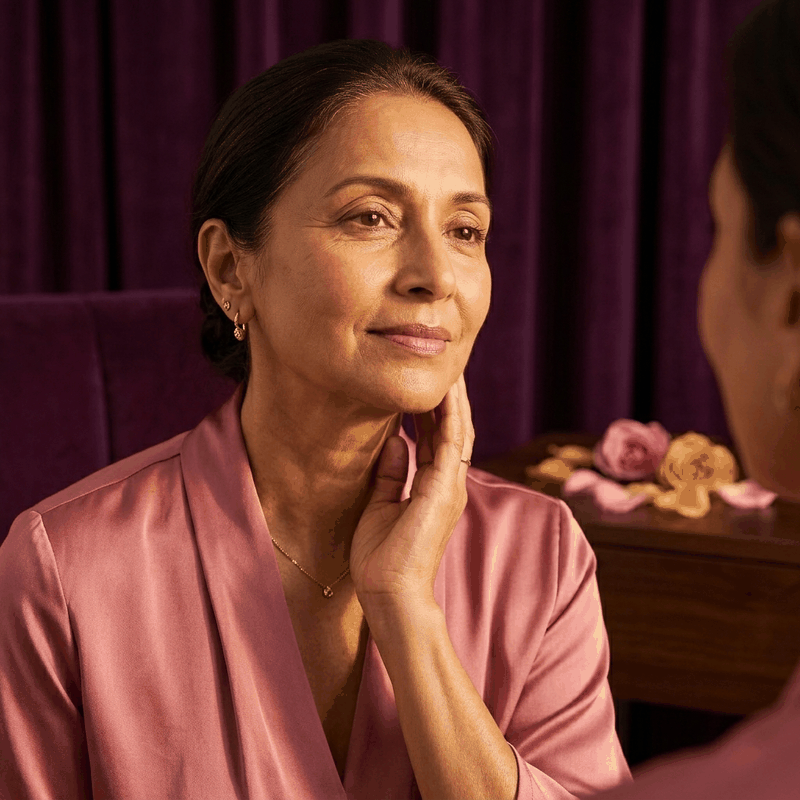
Tomorrow morning, before you reach for the comb, press play on The Woman in the Mirror. Or tell Sakhi how you're feeling about your reflection, and she'll suggest something gentle for that moment.
5 minutes. No mat. No mantra. Just you.
Questions women ask
Why is my hair thinning during menopause?+
Falling oestrogen means hair spends less time in its growing phase, so many women notice it becoming finer and sparser, especially along the parting. Stress, low iron, thyroid changes and some medicines can add to it.
Does menopause change your skin?+
Yes. As oestrogen falls, many women find their skin becomes drier, thinner, itchier or more sensitive, and products they've used for years may suddenly sting. A gentle cleanser and a richer moisturiser can help.
When should I see a doctor about hair loss in menopause?+
See a doctor or dermatologist if hair loss is sudden, heavy or patchy, if you have bald spots or a sore scalp, or if it comes with tiredness, feeling cold or very heavy periods. Blood tests can check for other causes.
Is it normal to feel sad about thinning hair?+
Yes. Grieving the reflection you've known for decades is natural, and it isn't vanity. Give yourself room to feel it, and treat the woman in the mirror with the same kindness you'd offer a friend.
Listen free, wherever you are