Hormonal Headaches in Perimenopause: 5 Minutes to Soften the Edges
It's four in the afternoon and the band around your head has been tightening since lunch. The light from the window feels too bright. The screen feels too bright. Someone in the next room laughs, and even that lands somewhere behind your left eye. You've had a glass of water and a painkiller, and you still have dinner, homework and a long phone call ahead of you.
If headaches have started behaving differently in your 40s, you are not imagining it. And you are not being dramatic when you say सिर भारी है, my head just feels so heavy.
In short: Hormonal headaches in perimenopause are common because oestrogen rises and falls unpredictably in the years before menopause, a stretch that lasts about 4 years on average and sometimes up to 10. Many women notice their headaches change in timing, pattern or strength. A 5-minute practice of slow breathing and releasing the jaw, forehead and shoulders may help soften the edges.
Why do hormonal headaches get worse in perimenopause?
For years your hormones followed a rhythm you could almost set a calendar by. In perimenopause, that rhythm gets patchy. Oestrogen can climb higher than usual one month and drop sharply the next, and for many women it is the drop that seems to matter. If you have always had headaches around your period, you may find they come more often now, or at odd times, or without the warning signs you used to get.
Other things pile on. Night sweats break your sleep, and broken sleep makes a sore head more likely. You skip lunch because the day ran away from you. You clench your jaw through a stressful meeting without noticing. You hold your breath while reading a list of things still to do. None of this is your fault. It is simply a lot for one body to carry at once.
Some women find their headaches ease after menopause, once hormones settle. Others don't. Either way, you don't have to grit your teeth and wait it out.
What does a hormonal headache feel like?
There's no single shape. Some women describe a tight band across the forehead. Some feel a throb on one side, or pressure behind the eyes. Some feel sick, or sensitive to light and sound, and just want a dark, quiet room.
What tends to make them feel "hormonal" is the pattern. They cluster around certain days, or arrive after a run of bad nights, or turn up alongside other perimenopause changes like hot flushes, low mood or word-finding trouble. Keeping a simple note for a few weeks (the date, how you slept, what you ate, where you are in your cycle if you still have one) can show you a pattern you'd never spot otherwise. The daily check-ins in the MySakhi app can keep that note for you in a few taps.
You don't need to push through. You need a softer way in.
Here is the old way: take something, keep going, ignore it until it screams. Not this. This instead: notice the first tightening, pause for 5 minutes, and give your nervous system a chance to stand down.
A headache often comes with a body that's braced. Shoulders up near the ears. Jaw locked. Forehead pulled tight. Breath high and shallow in the chest. Slow breathing, at around 6 breaths a minute, is linked with calmer heart-rate patterns and the body's "rest and digest" response. It won't switch off a hormonal shift. But it may ease the tension wrapped around the pain, and that can be the difference between a terrible afternoon and a bearable one.
You can't do this wrong. You don't need a quiet room or a mat. You can do it at your desk, in the car before you walk into the house, or lying on the bed with the curtains half drawn.
Try this now: a 5-minute practice to soften the edges
- Dim what you can. Take off your glasses, lower your screen brightness or close your eyes, and loosen anything tight, like a hair clip or a firm bun.
- Unclench your jaw. Let your teeth part slightly and rest your tongue on the floor of your mouth.
- Breathe in gently through your nose for a count of 4, then out through soft lips for a count of 6. Keep going for about 2 minutes.
- On each out-breath, let one place go: your forehead, the space between your eyebrows, your shoulders, your hands.
- Rest your warm palms over your closed eyes, or lay a cool damp cloth across your forehead, and stay with the slow breath for one more minute.
- Sip some water before you open your eyes and carry on.
If counting feels like work, just make each out-breath a little longer than the in-breath. And if the pain is still there afterwards, that's okay. You haven't failed. You've given your body five kinder minutes than it would otherwise have had.
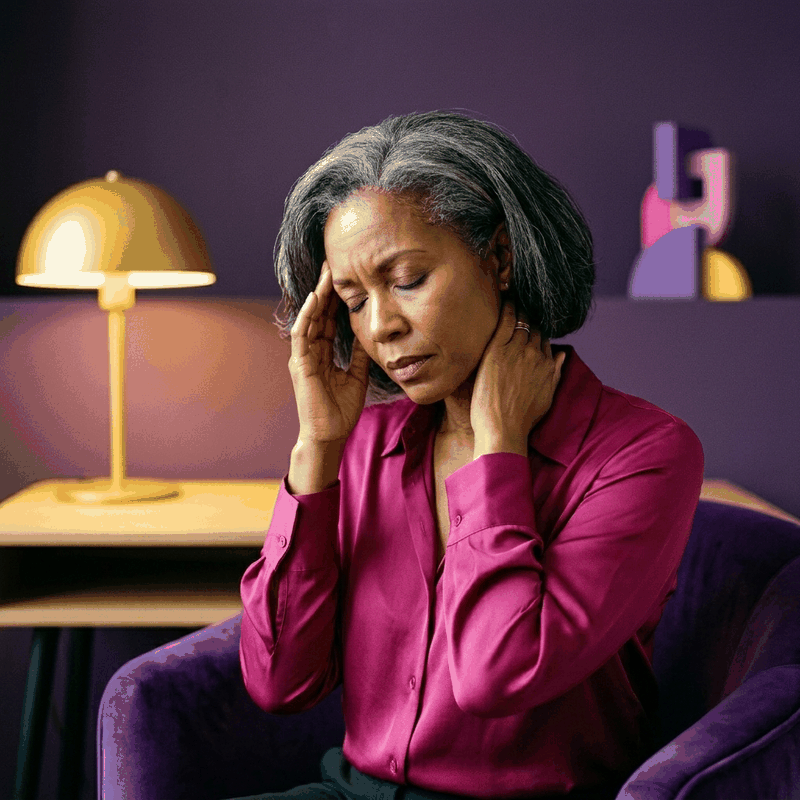
If you'd rather be guided, Soften the Edges is a 5-minute guided meditation made for exactly this moment. You can also find it in the MySakhi library.
When is a headache an emergency?
Most hormonal headaches are miserable but not dangerous. Some headaches are different, and it is always okay to get checked.
Get urgent medical care straight away if you have:
- a sudden, severe headache, the worst you have ever had
- any change in your vision
- weakness, numbness or drooping on one side of the face or body
- confusion, or trouble speaking
See your doctor soon if your headaches are new since 40, are coming more often or getting stronger, wake you from sleep, or no longer respond to what used to help. Tell your doctor about your cycle and any other perimenopause symptoms too, so you can talk through which treatment options might suit you. You are allowed to take up that appointment time.
It's okay to stop for this
So many of us were raised to believe a headache is not a good enough reason to stop. Make the rotis. Finish the report. Smile at the guests. What if pausing for 5 minutes isn't weakness, but the most sensible thing you could do for the rest of your day?
You are allowed to say, "I need five minutes with my eyes closed," and mean it. This counts as looking after your family too, because they need you, not a version of you running on gritted teeth.
If your headaches come alongside other changes, our full list of menopause symptoms may help you see the bigger picture. And if they tend to land after a bad night, the wind-down for when you can't fall asleep is a good next read.
When the next one starts, tell Sakhi how your head feels. She's free, and she'll suggest a short practice or some quiet music for that moment.
5 minutes. No mat. No mantra. Just you.
Questions women ask
Why do I get more headaches in perimenopause?+
Oestrogen rises and falls unpredictably in perimenopause, and for many women those shifts, especially the drops, can trigger headaches. Broken sleep from night sweats, stress and skipped meals can add to it.
Will hormonal headaches stop after menopause?+
Some women find headaches ease once hormones settle after menopause, but not everyone does. If headaches are affecting your life, talk to your doctor about what might help.
Can breathing help a hormonal headache?+
Breathing won't change your hormones, but many women find slow breathing eases the tension wrapped around the pain. Try breathing out a little longer than you breathe in for 5 minutes while relaxing your jaw and shoulders.
When should I worry about a headache in perimenopause?+
Get urgent care for a sudden severe headache, vision changes, weakness or confusion. See your doctor if headaches are new since 40, getting worse, waking you up or not responding to what used to help.
Listen free, wherever you are