Ragas for Anxiety: Indian Classical Music for Calmer Evenings
You're sitting in the car outside the house. The engine is off, the bags are on the back seat, and you have five minutes before someone needs you. Your chest feels tight for no clear reason. That fluttery घबराहट, the jittery unease, has been with you all day.
You don't need to fix the feeling before you walk in. You need a few minutes of something that does not ask anything of you.
In short: There is no single proven raga for anxiety, but many women find slow, steady ragas calming. Bageshri, Yaman and Hansadhwani are good places to start. Pairing music with slow breathing at about 6 breaths a minute is linked with calmer heart-rate patterns and the body's rest and digest response. Choose the raga that settles you.
Why does anxiety get louder in perimenopause?
If you have always been the calm one and now you feel on edge, you are not losing yourself. Many women notice new or stronger anxiety in perimenopause, often without a clear trigger. It can show up as a racing heart, a tight chest, a sense of dread or a mind that will not stop planning.
Hormones shifting is part of the picture. So is everything else this stage of life tends to bring: ageing parents, teenagers, work, a body that suddenly behaves differently. It's okay to find this hard. It is a lot.
For a fuller look at what is going on, read perimenopause anxiety and how to manage it. If yours tends to arrive first thing, morning anxiety in perimenopause is written for you.
Can a raga really help anxiety?
Let's be honest about what music can and cannot do. No study shows that one raga treats anxiety. Raga time theory, the tradition of ragas for certain hours, is lived experience rather than proven science.
What music can do is give your attention a gentle place to land. A slow raga, with a steady drone underneath and no lyrics, gives your mind one simple thing to follow instead of twenty worries. And when you let your breath slow down alongside it, your body has a chance to follow. Slow breathing at around six breaths a minute is linked with calmer heart-rate patterns and the rest and digest side of the nervous system.
Not this: trying to think your way out of anxiety. This instead: letting sound and breath do the work for a few minutes.
Which ragas help with anxiety?
Every track below is original MySakhi music, instrumental, tuned to 432Hz and built on a raga from the catalogue.
Raga Bageshri: for the restless night mind
Bageshri is traditionally a late-night raga, tender and unhurried. It suits the anxiety that waits until you lie down. "The River Moves At Night." carries Bageshri on the sarod, about four and a half minutes, made for restless nights when worry keeps you awake.
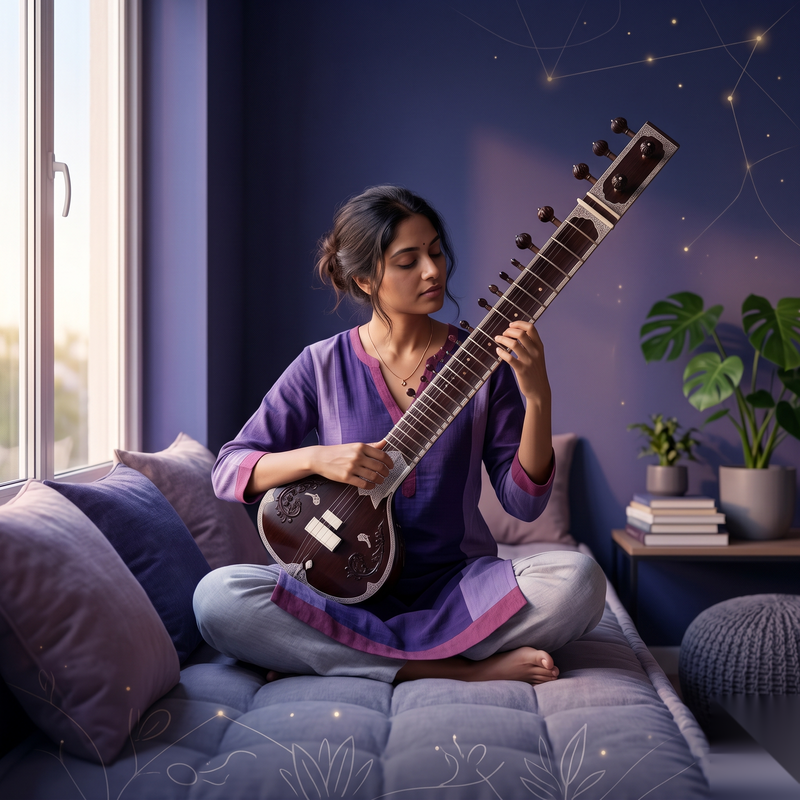
If you prefer a lighter sound, "Your Breath Already Knows." brings Bageshri to the sitar for anxious, wakeful hours.
Raga Hansadhwani: for when stress feels sharp
Hansadhwani has a bright, open quality, and in the Hindustani tradition it is usually heard in the evening. "Breathe. The Flute Remembers." pairs it with the bansuri, the bamboo flute, for about five minutes. It was made for stress, anxiety and restlessness, the kind that sits in your shoulders.
Five minutes of bansuri. Press play on Breathe. The Flute Remembers. and let your breath follow the flute.

Raga Yaman: for the end of a long day
Yaman is an early evening raga with a soft, settling mood. "Evening Doesn't Ask. It Holds." sets it on the sitar for stress and tension at the end of the day. It is a good choice for that car-outside-the-house moment, or the five minutes after everyone has finally gone to bed.

Want one more? "Be Still. The Water Knows." uses Raga Chandrakauns with the sitar and was made for anxiety and a racing mind.
Try this now: a 5-minute raga reset for anxiety
This works in a parked car, at your desk with earphones, or sitting on the closed loo lid. You can't do it wrong.
- Press play on one of the ragas above at a low volume, and rest your phone on your lap.
- Place one hand on your chest and one on your belly, and notice where you are holding your breath.
- Take two short inhales through your nose and one long, slow exhale through your mouth.
- Repeat that cyclic sigh for a few minutes, letting each exhale be longer than the last.
- For the final minute, breathe normally and simply listen for the lowest note in the music.
That breath in step 3 is called cyclic sighing. A 2023 Stanford study found that 5 minutes a day of it for a month improved mood and lowered breathing rate, and in that study it helped more than mindfulness meditation. Five minutes is enough.
Where can you listen to MySakhi ragas?
MySakhi is a free app for women in perimenopause and menopause, with short guided breathing practices, sleep stories, calming 432Hz music and Sakhi, an AI companion who suggests what might help tonight. You can also listen free at mysakhi.life on any phone.
On Spotify, find the artist MySakhi and look for the album Music for Anxious Hours 432Hz. On Apple Music and Amazon Music, search MySakhi. If evenings tip into sleeplessness, evening ragas for sleep picks up where this leaves off.
Not sure which raga suits tonight's mood? Tell Sakhi how you feel, and she will suggest a track or a breathing practice for that moment.
When is anxiety a reason to see a doctor?
Music is support, not treatment. If anxiety is affecting your sleep, work or relationships, please talk to your doctor. The UK's NICE menopause guidance includes CBT as one option for low mood linked to menopause, and there are other options worth discussing too. If you are not sure what else might be connected, the full list of menopause symptoms can help you spot patterns to raise.
Get urgent care if you have chest pain, fainting, breathlessness, or palpitations that do not settle. And if you ever have thoughts of harming yourself, contact your local emergency services or a crisis helpline now. You are allowed to ask for help.
Tonight, before you walk back into the house, give yourself five minutes with The River Moves At Night. What if those five minutes are the kindest part of your day?
5 minutes. No mat. No mantra. Just you.
Questions women ask
Which raga is good for anxiety?+
No raga is proven to treat anxiety, but many women find slow ragas such as Bageshri, Yaman and Hansadhwani calming. The right one is the raga that helps your body settle.
Can Indian classical music reduce anxiety?+
Slow, instrumental music may help you feel calmer, especially when you let your breathing slow alongside it. Slow breathing at about 6 breaths a minute is linked with calmer heart-rate patterns.
Is anxiety normal in perimenopause?+
Many women notice new or stronger anxiety in perimenopause. It is common, but if it affects your daily life, talk to your doctor. Seek urgent care for chest pain, fainting or palpitations that do not settle.
Where can I find MySakhi music for anxiety?+
MySakhi's raga music is free in the MySakhi app and at mysakhi.life, on Spotify under the artist MySakhi, including the album Music for Anxious Hours 432Hz, and on Apple Music if you search MySakhi.
Listen free, wherever you are