How to Start Meditating During Menopause: A No-Nonsense Guide for Beginners
Everyone says meditate. Your doctor. Instagram. That WhatsApp forward from your aunt. But nobody tells you how to actually do it when your mind is racing, your body is overheating, and you have 15 things on your to-do list.
Why Meditation Works for Menopause
This isn't spiritual theory. Many women find a short daily practice helps them feel less stressed, sleep a little better and cope with anxious moments. And it does not need to be long. A 2023 Stanford study found that 5 minutes a day of cyclic sighing (two breaths in through the nose, one long breath out through the mouth) improved mood over a month.
The idea is simple. Slow, steady attention to your breath helps engage your parasympathetic nervous system, your body's rest-and-repair mode. During menopause, your fight-or-flight system can feel stuck in overdrive. A few minutes of practice is a way to press pause.
The One-Minute Method
Forget 30-minute meditation marathons. Start with one minute.
Sit anywhere. You don't need a special cushion or a quiet room. Your bed, your car (parked), your office chair: all fine.
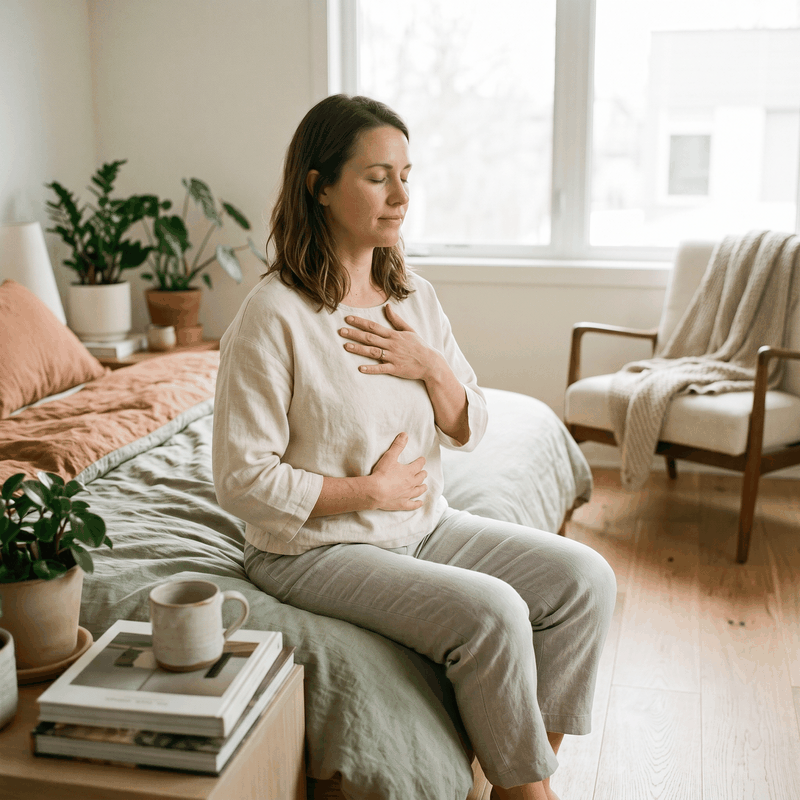
Close your eyes. Take one deep breath in through your nose. Feel your chest rise. Then breathe out slowly through your mouth. Feel your shoulders drop.
Now just breathe normally for the remaining 50 seconds. When a thought comes (and it will, probably within seconds), notice it and go back to your breath. That's it. That's meditation.
The goal is not an empty mind. It's noticing when your mind wanders and gently bringing it back. Every time you do that, you're strengthening your brain's attention circuits. It's a mental bicep curl.
It is okay if your mind wanders a hundred times. You cannot do this wrong.
Common Mistakes
Waiting for the perfect conditions. There are none. Meditate in the chaos.
Judging yourself for thinking. Thoughts during meditation are not failures. They're the entire point, because noticing them is the practice.
Trying too hard to relax. Meditation isn't about forcing relaxation. It's about observing what is, without trying to change it.
Starting with too much time. One minute daily for a week is better than one 30-minute sitting that makes you give up.
Building the Rhythm
Attach meditation to something you already do. After your morning chai. Before you check your phone. Right after brushing your teeth. Linking it to something you already do makes it feel automatic.
If you want to, add a minute each week. Week 1: one minute. Week 2: two minutes. There is no target. Five minutes is plenty, and one minute still counts.
Guided vs Unguided
For beginners, guided meditation is easier. Someone tells you what to do, so your mind doesn't wander as much. As you get more comfortable, you can switch to unguided (just breath awareness in silence).
If anxiety is what brings you here, try the 4-7-8 breath for perimenopause anxiety. If it's sleep, start with this 5-minute practice for 2am wake-ups.
How Sakhi Makes It Easy
Tell Sakhi how you're feeling (anxious, can't sleep, low, stressed) and she'll recommend a specific guided practice from our library. All free, all designed for women going through exactly what you're going through. No experience needed. Just press play.
Questions women ask
How long should a beginner meditate?+
Start with one minute. Five minutes is plenty for most days, and one minute still counts. A little, often, matters more than a long practice you dread.
What if my mind keeps wandering?+
That is normal, and it is not failure. Noticing that your mind has wandered and gently coming back to your breath is the practice itself. You cannot do this wrong.
Do I need a quiet room or a mat?+
No. Your bed, a parked car or an office chair all work. You don't need special clothes or a cushion. You just need a minute and your breath.
Is guided or unguided meditation better for beginners?+
Guided practice is often easier at first, because a voice gives your mind something to follow. Once you feel comfortable, you can try sitting quietly with your breath.
Listen free, wherever you are